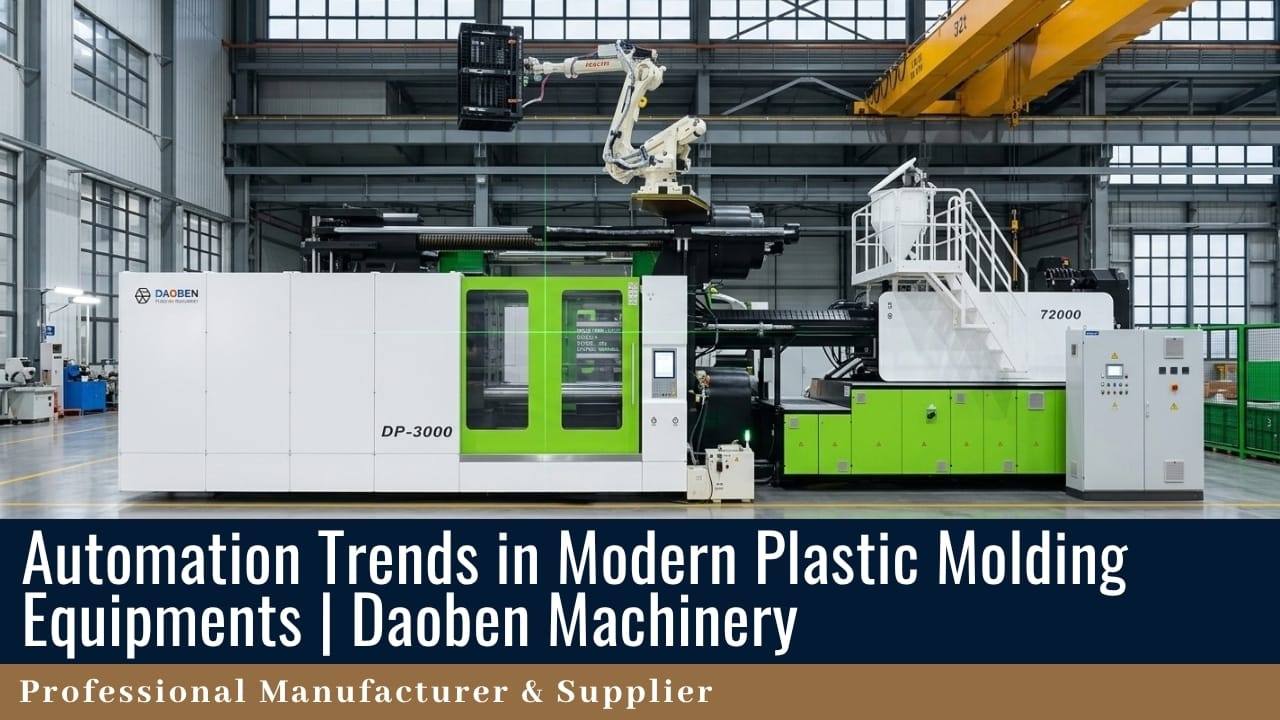
With the deep implementation of Industry 4.0, the plastic molding industry is moving away from traditional manual, extensive production models and rapidly iterating towards fully automated production characterized by high precision, intelligence, flexibility, and green technology. The automation upgrade of mainstream plastic molding equipment such as injection molding machines, extruders, and blow molding machines is a core lever for improving quality and efficiency and reducing costs in the manufacturing industry. This article analyzes the automation development trend of modern plastic molding equipment from five dimensions: equipment drive, intelligent control, production line integration, operation and maintenance management, and energy-saving production.
Quick Answer: What Is Automation in Plastic Injection Molding?
Automation in plastic injection molding is the use of robots, machine controls, sensors, and auxiliary equipment to perform production tasks with less manual intervention. It helps manufacturers improve process consistency, reduce repetitive handling, monitor production, and connect different stages of manufacturing.
Drive Architecture Upgrade: Full Electrification Replaces Traditional Hydraulics
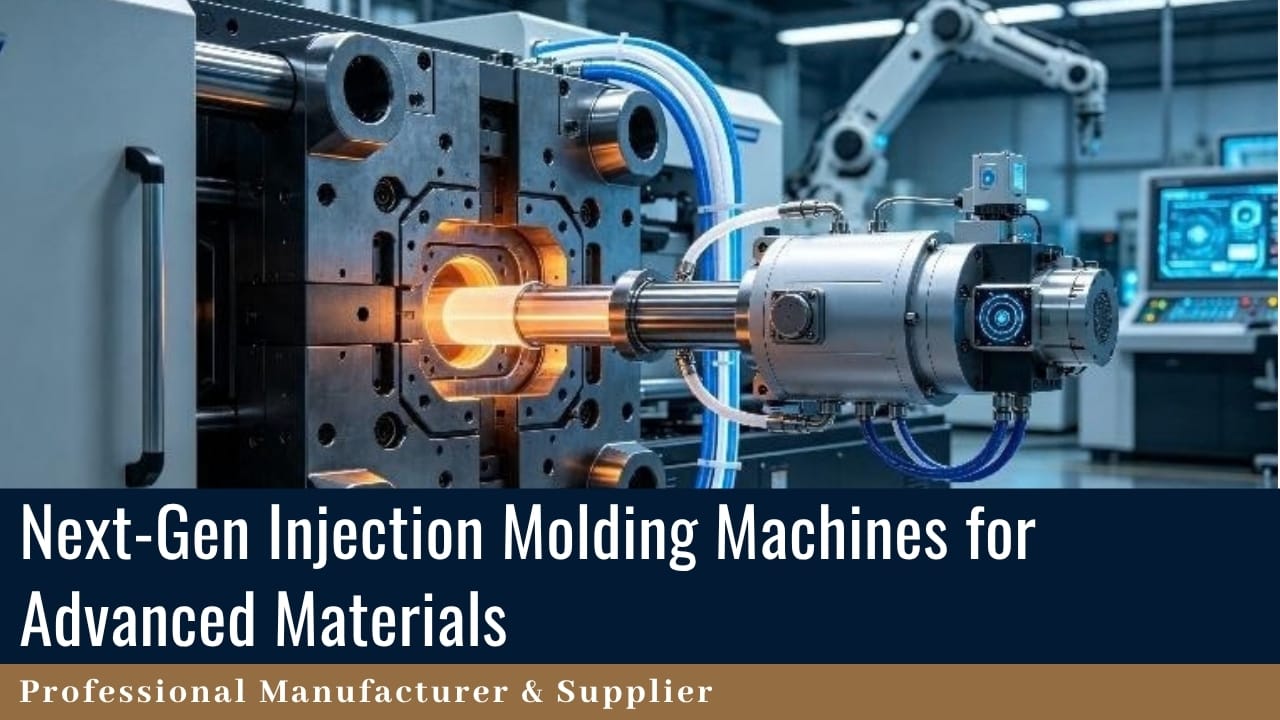
The innovation of the equipment’s power drive system is the foundation for the automation upgrade of plastic molding equipment. The core trend is the replacement of traditional hydraulic drives with full electric and servo-driven systems, completely solving the pain points of low precision, high energy consumption, and poor stability in traditional plastic injection molding machines.
Traditional hydraulic plastic molding equipment relies on hydraulic oil circuit transmission, which suffers from problems such as large pressure fluctuations, oil leakage and pollution, high noise, and serious energy waste. Furthermore, molding accuracy is greatly affected by oil temperature and pressure, making it difficult to meet the production requirements of precision plastic parts. Modern injection molding equipment generally employs a permanent magnet synchronous servo motor paired with a ball screw drive architecture, establishing a triple closed-loop control system for current, speed, and position to achieve sub-millisecond response speeds. Related data shows that all-electric injection moulding machines can save 30%-70% energy compared to traditional hydraulic equipment, improve molding repeatability by over 50%, significantly reduce noise, and significantly enhance equipment operational stability.
Manual vs. Automated Injection Molding
Important: Automation does not eliminate the need for operators. Skilled personnel remain essential for setup, troubleshooting, maintenance, and quality control.
| Production task | Manual process | Automated process |
|---|---|---|
| Part removal | Operator removes parts | Robot removes parts |
| Material loading | Operator loads material | Automatic loader supplies material |
| Part inspection | Worker checks products | Vision systems can inspect products |
| Production tracking | Manual records | Machine data and monitoring systems |
| Material transfer | Manual movement | Conveyors or automated handling |
| Process supervision | Operator checks machine | Controls provide process information |
Control System Iteration: AI-Powered Intelligent Adaptive Control
The core of automation has upgraded from “automatic mechanical operation” to “intelligent autonomous decision-making,” relying on IoT, AI, and edge computing technologies to achieve fully automatic optimization and intelligent control of the molding process, eliminating reliance on manual parameter adjustments.
1. Adaptive Optimization of Injection Molding Machine Process Parameters
Traditional equipment requires manual adjustment of parameters such as temperature, pressure, injection speed, and holding time based on material characteristics and mold conditions, resulting in long debugging cycles and low error tolerance. Modern intelligent molding equipment is equipped with a massive number of sensors, enabling real-time collection of core data such as mold cavity pressure, material temperature, and melt flow rate. AI algorithms dynamically correct process parameters. Even with variations in raw material batches or environmental temperature fluctuations, the equipment can autonomously adapt, ensuring high uniformity in the size and appearance of molded parts and significantly reducing the defect rate.
2. Intelligent Visual Quality Inspection Integration
The new automated molding production line integrates an AI visual inspection module, which can complete defect detection, dimensional verification, and sorting of defective parts within 5 seconds. It simultaneously links with the plastic molding machine to adjust production parameters, achieving a closed-loop automation of “production-inspection-optimization,” replacing the traditional manual quality inspection mode. The inspection efficiency and accuracy far exceed manual standards.
3. Key Automation Trends in Plastic Molding Equipment
Note: Actual benefits depend on the machine configuration, application, factory setup, and production conditions.
| Automation trend | Main function | Potential benefit |
|---|---|---|
| Robotic part removal | Removes molded parts from the machine | Reduces manual handling |
| Smart machine controls | Regulates molding parameters | Supports consistent production |
| Automatic material handling | Feeds plastic materials to machines | Reduces manual material loading |
| Production monitoring | Tracks cycles, alarms, and machine data | Helps identify production issues |
| Automated quality inspection | Checks parts using cameras or sensors | Supports defect detection |
| Energy-efficient systems | Optimizes machine operation and energy use | Can reduce operating costs |
| Connected factory systems | Connects machines and auxiliary equipment | Improves production coordination |
Production Mode Innovation: Flexible Integrated Fully Automated Production Line
Single-equipment automation can no longer meet the market’s demand for customized production with multiple varieties and small batches. Equipment automation is gradually extending to flexible automated production lines, achieving integrated linkage of horizontal injection molding machines, molds, auxiliary machines, and robots.
On the one hand, it enables rapid mold changeover and flexible switching. Modern automated molding equipment features a modular structure and an automatic mold-changing system, coupled with an intelligent scheduling program, enabling rapid switching between molds and production processes to adapt to the production of plastic parts of different specifications. Some high-end equipment can complete mold switching within minutes, completely solving the problems of time-consuming mold changes and cumbersome debugging in traditional production lines, significantly improving the adaptability of the production line.
On the other hand, it achieves fully unmanned operation throughout the entire process. By integrating auxiliary equipment such as robotic arms, conveyor belts, crushers, and dryers, a fully automated molding production unit is built, completing the entire automated operation process from automatic feeding, melt molding, part removal, shearing, conveying, packaging, and scrap recycling. Without human intervention, it can achieve continuous and stable production 24 hours a day, effectively solving the problems of low efficiency, large human error, and high labor costs associated with manual operation, increasing the overall production line capacity by more than 20%.
Upgraded Operation and Maintenance System: Predictive Intelligent Automated Operation and Maintenance
Traditional equipment relies on manual periodic inspections and post-failure repairs, resulting in significant downtime losses and low operation and maintenance efficiency. Modern automated molding equipment, relying on industrial Internet of Things (IoT) technology, upgrades the operation and maintenance model from “passive maintenance” to “proactive prediction.”
The equipment is equipped with intelligent sensors that monitor the real-time operating status of the motor, bearings, oil circuits, and temperature control system, continuously collecting data on vibration, temperature, and wear. Through big data analysis, it predicts wear and potential malfunctions in equipment components. The system can automatically generate maintenance reminders and plans, proactively avoiding downtime and enabling predictive maintenance. Simultaneously, the equipment automatically records production data, fault logs, and process parameters, supporting cloud-based data traceability. This provides data support for equipment maintenance, process optimization, and production review, significantly reducing equipment failure rates and maintenance costs.
Green Automation
Energy-Saving, Low-Carbon, and Precise Management Under the dual-carbon context, automation upgrades and green production are deeply integrated. The equipment achieves energy saving, emission reduction, and pollution reduction through intelligent control, achieving a balance between high efficiency and environmental protection.
On the one hand, intelligent energy-saving control. The plastic injection moulding’s servo drive system can dynamically adjust power output according to production load and automatically enter sleep mode during periods of no operation, avoiding the problem of continuous energy consumption under idle conditions common in traditional equipment. At the same time, the intelligent temperature control system can precisely manage the heating range and temperature accuracy, reducing heat loss and significantly lowering overall energy consumption. On the other hand, automated waste closed-loop treatment systems can automatically recycle, crush, and reshape production scraps, achieving fully automated closed-loop processing, reducing raw material waste and solid waste emissions, aligning with the trend of green industrial development.
In summary, the automation development of modern plastic molding equipment exhibits five core trends: electrification of drives, intelligent control, flexible production lines, predictive operation and maintenance, and green production. Automation upgrades are no longer just about optimizing the function of a single piece of equipment, but rather a comprehensive, multi-dimensional intelligent transformation. In the future, with the deep integration of technologies such as digital twins and AI big data models, plastic molding equipment will achieve a higher degree of autonomous production and optimization, driving the entire plastics processing industry towards high-end, high-efficiency, and intelligent transformation and upgrading.
Why Daoben?
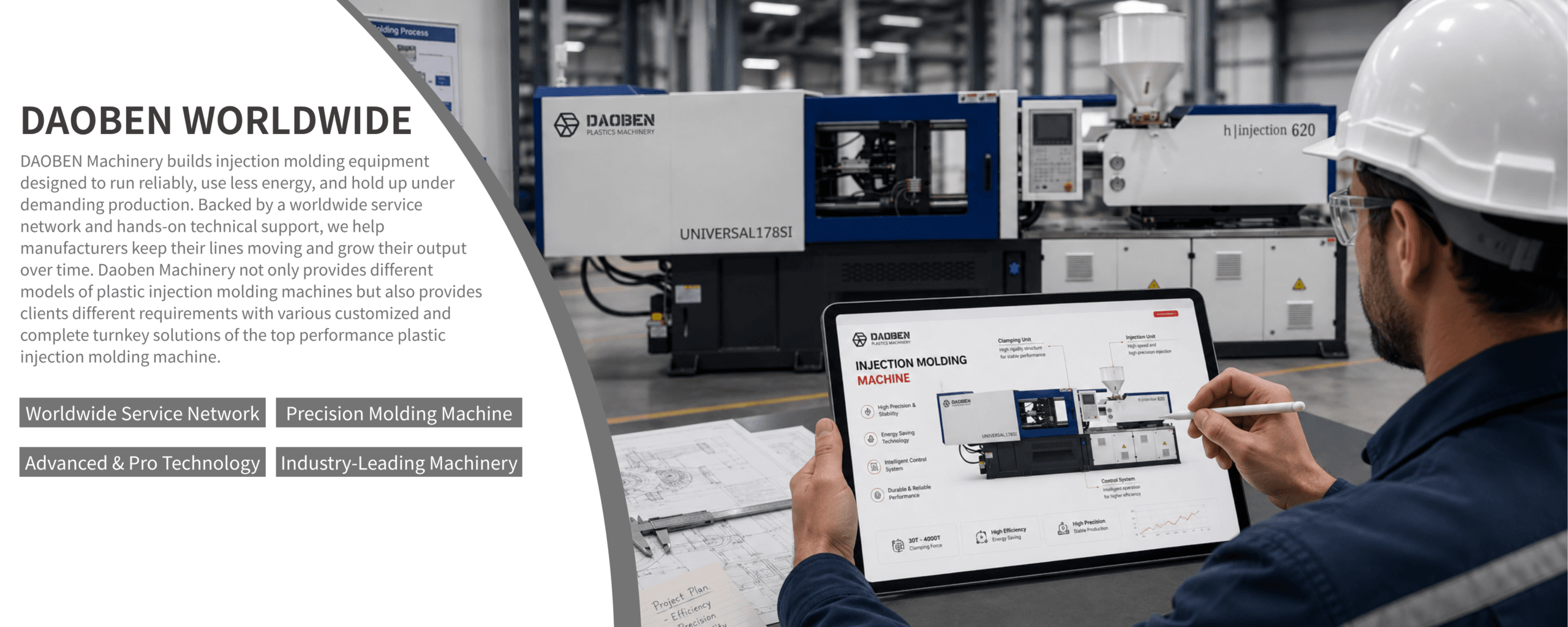
As plastic manufacturers move toward smarter and more automated production, the choice of molding equipment becomes increasingly important. Daoben Machinery focuses on developing injection molding machines that combine reliable mechanical performance with practical automation features for modern manufacturing environments.
Daoben machines are designed to help manufacturers improve process consistency, reduce unnecessary manual work, and maintain stable production cycles. Depending on the machine series and application, automation can be integrated into areas such as machine control, injection parameters, material handling, and production monitoring.
Another advantage is the wide range of machine configurations available for different manufacturing requirements. From everyday plastic components to demanding automotive, packaging, household, medical, and industrial applications, Daoben provides injection molding solutions across a broad range of clamping capacities.
For manufacturers planning to upgrade an existing production line or build a more automated molding operation, Daoben Machinery offers equipment designed with both current production needs and future expansion in mind. The combination of automation capability, stable operation, and application-focused machine design makes Daoben a practical choice for modern plastic injection molding.