
Large plastic parts — automotive bumpers, industrial pallets, 200-liter drums, appliance panels — require clamping forces above 500 tons. Traditional three-platen toggle machines at that tonnage occupy massive floor space because the toggle mechanism extends far behind the moving platen. A two platen injection molding machine eliminates the toggle entirely and replaces it with a direct hydraulic lock on the tie bars. The result is a machine that delivers equal clamping force in a footprint up to 30% shorter than a conventional toggle design.
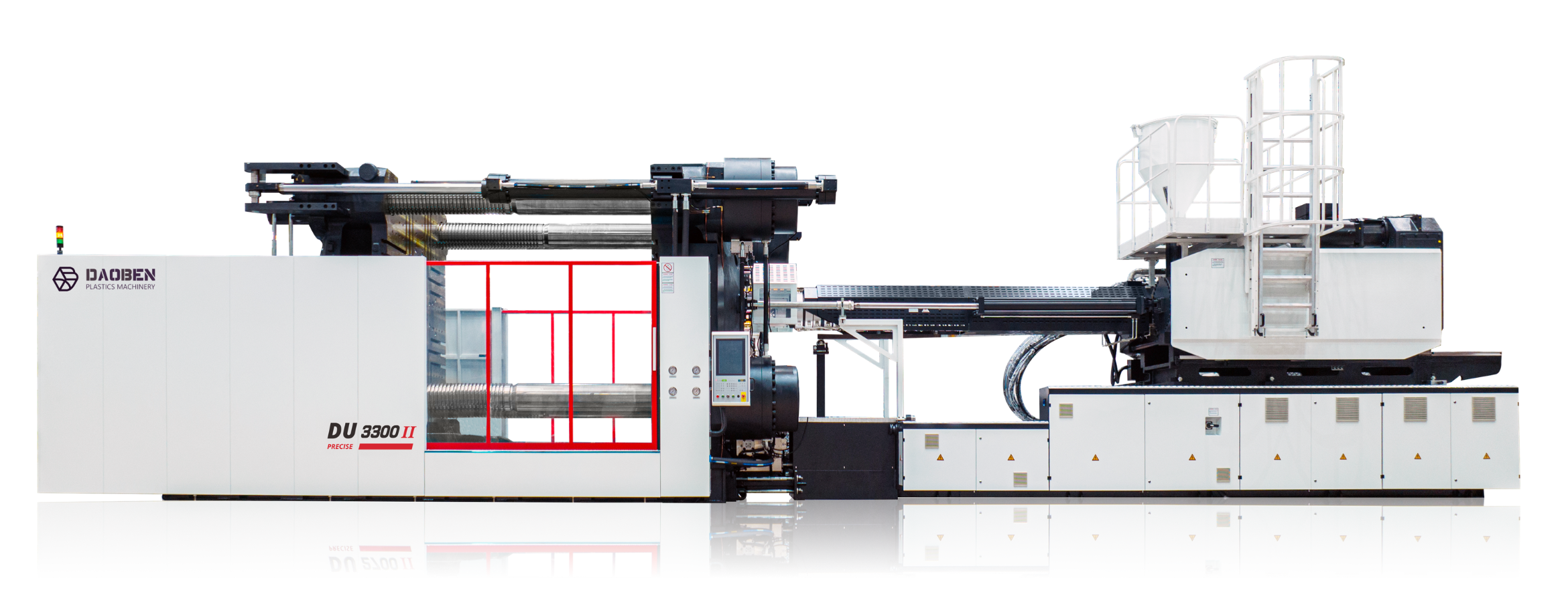
Daoben’s DU series two-platen injection molding machine is built for manufacturers who mold large, deep, or complex parts that demand high tonnage with precision. It features a European-style non-contact tie bar system, independent tie bar position adjustment, a KEBA controller from Austria, and a permanent magnet synchronous servo motor.
This article explains how a two platen injection molding machine works, what the DU series offers that standard toggle machines cannot, and which large-part applications benefit most from this design.
Quick Answer: A two platen injection molding machine uses direct hydraulic clamping on the tie bars instead of a toggle mechanism. This eliminates the rear platen and toggle linkage, cutting overall machine length by up to 30%. The Daoben DU series offers independent tie bar adjustment, a KEBA controller, and a permanent magnet servo motor for precision control of large-part molds.
How a Two Platen Injection Molding Machine Differs From Toggle Designs
A two platen injection molding machine has only two platens: a fixed platen and a moving platen. The moving platen travels on guide rails or tie bars and is locked in position by hydraulic nuts or stroke-lock mechanisms on each tie bar. There is no toggle linkage, no rear platen, and no crosshead — all components that add significant length to a conventional three-platen machine.
In a toggle machine, the clamping force is generated mechanically through the toggle linkage. This works well up to about 500–600 tons. Above that, toggle designs require very large toggle pins and bushings that experience heavy wear and demand frequent lubrication. The tie bar length increases, the machine footprint grows, and maintenance intervals shorten.
The DU series uses a European-style non-contact tie bar system that eliminates tie bar wear during mold open/close movements. Because the tie bars do not contact any sliding surface during travel, their service life is significantly longer than on toggle machines. According to Plastics Technology magazine, two-platen designs have become the preferred configuration for large-tonnage machines across European and Asian manufacturers since 2015.
DU Series Two Platen Injection Molding Machine: Core Features
The DU series is not just a compact footprint. Every subsystem is engineered for the specific challenges of large-part molding. Here is what separates this machine from standard two-platen designs.
Independent Tie Bar Position Adjustment
Each of the four tie bars adjusts independently. This allows operators to fine-tune clamping force distribution across the mold face. For large, asymmetric molds or molds with off-center cavities, this feature is critical. Uneven clamping causes flash on one side and short shots on the other. Independent adjustment solves this without shimming or mold modification.
KEBA High-End Controller
The DU series uses a controller from KEBA AG (Austria), a specialist in industrial automation and injection molding control. KEBA controllers are proven across global machine manufacturers for processing accuracy and long-term reliability. Closed-loop control of injection speed, pressure, position, and temperature runs across all machine axes with real-time monitoring and automatic deviation correction.
Permanent Magnet Synchronous Servo Motor
The hydraulic unit uses a permanent magnet synchronous motor matched with a servo pump. This motor type provides high torque density and near-instant speed response. Independent pressure and flow control governs every machine action — mold close, injection, hold, cooling, and ejection — all tunable from the KEBA control interface.
Two Platen vs. Toggle: Specification Comparison for Large-Part Molding
The table below compares key performance factors between a two platen injection molding machine and a conventional toggle machine at equivalent clamping tonnage.
| Factor | Toggle Machine | Two Platen (DU Series) |
| Overall Machine Length | Longer (toggle extends rear) | Up to 30% shorter |
| Tie Bar Wear | Continuous contact | Non-contact system |
| Clamping Force Distribution | Fixed by toggle geometry | Individually adjustable |
| Mold Mounting Flexibility | Limited by toggle clearance | Full platen face usable |
| Floor Space Required | Larger | Smaller |
| Best For | Mid-tonnage, high speed | Large parts, deep molds |
For factories where floor space is limited or expansion is not feasible, the shorter footprint of a two platen injection molding machine can free up room for additional production lines or downstream equipment.
Ideal Applications for the DU Series Two Platen Machine
The two-platen design is most advantageous when the parts are large, the molds are deep, or the clamping tonnage exceeds 500 tons. Here are the applications where the DU series delivers the strongest return on investment.
Automotive Exterior and Structural Parts
Bumpers, fenders, door panels, and under-hood components typically require 800–2,000+ ton clamping force. The DU series’ independent tie bar adjustment ensures even clamp force across these large mold faces, preventing flash on Class A surfaces and reducing post-mold trimming.
Industrial Containers and Pallets
Plastic pallets, crates, and large-volume drums need deep molds and high tonnage. The DU series’ full platen face is usable for mold mounting because there is no toggle mechanism blocking access. This gives mold designers more freedom to size the mold without worrying about toggle interference.
Optical and Precision Large-Format Parts
The DU series achieves reduced residual stress and superior surface finish, making it suitable for optical lenses, thin-wall panels, and large precision components. The KEBA controller’s closed-loop accuracy and the synchronized mechanical platen guide ensure mold parallelism throughout the stroke.
For smaller precision parts under 268 tons, the EV Hybrid series provides servo-electric injection speed. For mid-range applications where energy savings are the top priority, the M8SII servo hydraulic series covers 90 to 1,700 tons.
Frequently Asked Questions
What is a two platen injection molding machine?
A two platen injection molding machine has only a fixed platen and a moving platen. It uses hydraulic tie bar locking instead of a toggle mechanism for clamping. This eliminates the rear platen and toggle linkage, making the machine up to 30% shorter than a toggle design of equal tonnage. It is ideal for large-part and deep-mold applications above 500 tons.
What controller does the DU series use?
The DU series uses a KEBA controller from KEBA AG in Austria. KEBA specializes in industrial automation and injection molding control. The controller provides closed-loop management of injection speed, pressure, position, and temperature across all machine axes. It supports real-time monitoring, automatic deviation correction, and stable output across extended production runs.
Can each tie bar be adjusted separately on the DU series?
Yes. The DU series two platen injection molding machine features independent tie bar position adjustment on all four tie bars. This allows operators to fine-tune clamping force distribution for asymmetric molds, off-center cavities, or large molds that require uneven force profiles to prevent flash and short shots.
What type of servo motor does the DU series use?
The DU series uses a permanent magnet synchronous servo motor paired with a servo pump. This motor type delivers high torque density and near-instant speed response. It provides independent pressure and flow control for every machine action, and its energy consumption drops to near-zero during idle and cooling phases.
How much floor space does the DU series save compared to a toggle machine?
A two platen injection molding machine like the DU series is typically up to 30% shorter than an equivalent-tonnage toggle machine. The exact space savings depend on the clamping force and mold size. For a factory running multiple large-tonnage machines, this can free significant floor area for additional lines or downstream equipment.
Large Parts Demand a Machine Built for Scale
Toggle machines work well for mid-tonnage, high-speed applications. But above 500 tons — where parts get bigger, molds get deeper, and floor space gets tighter — the two platen injection molding machine is the better engineering choice.
The Daoben DU series brings European two-platen design principles to a competitively priced platform. Independent tie bar control, a KEBA controller, and a permanent magnet servo motor give large-part manufacturers the precision and flexibility they need without the footprint penalty of conventional toggle designs.
Explore the full DU series two-platen specifications and browse Daoben’s complete injection molding machine range, or contact the Daoben engineering team to discuss your large-part application.