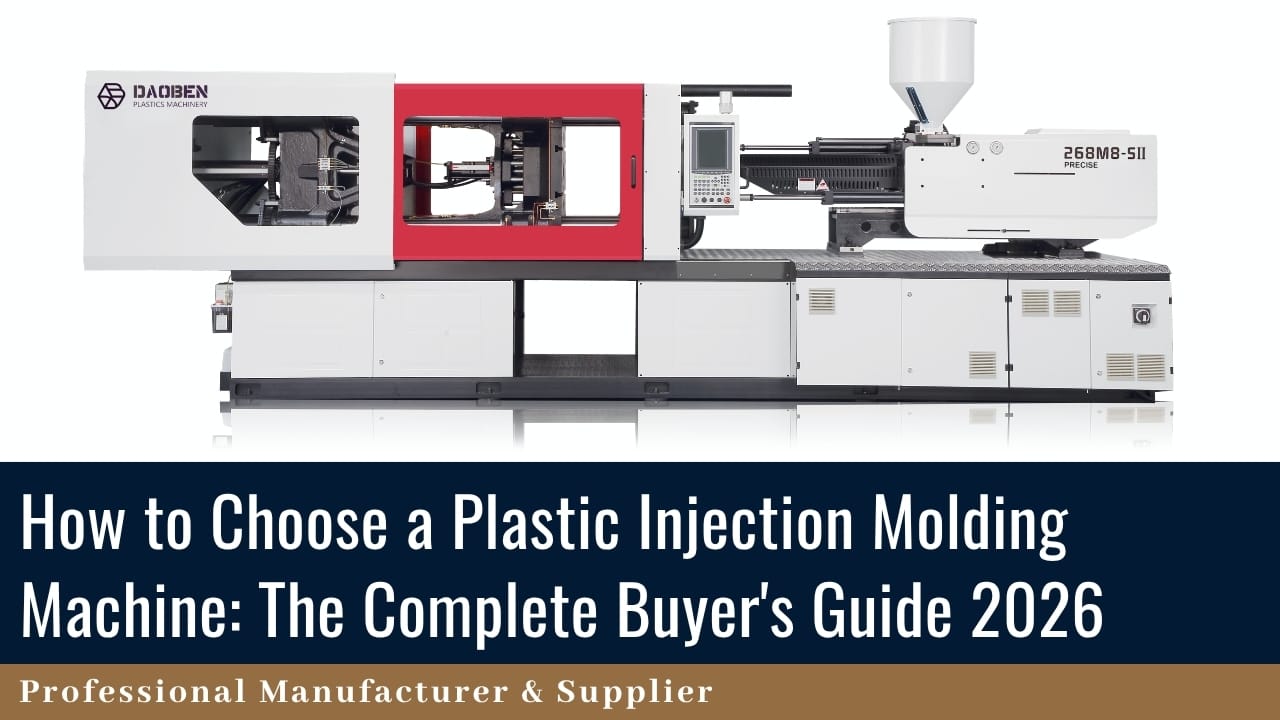
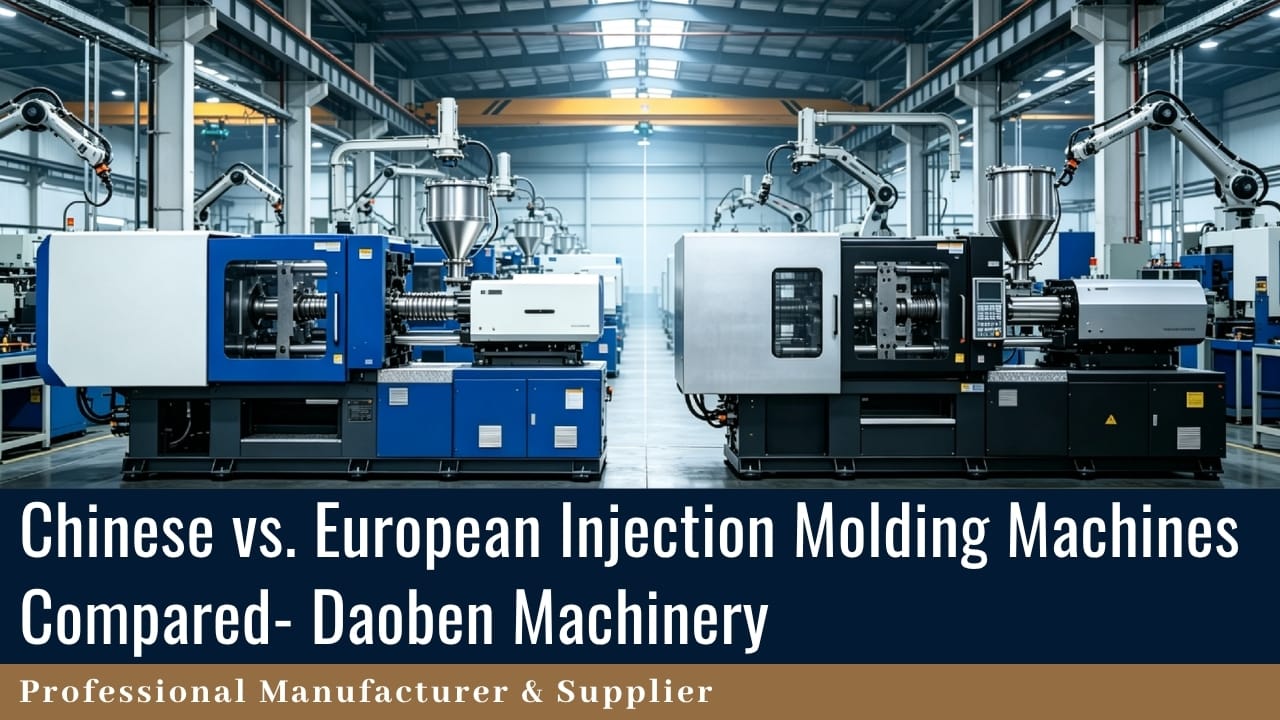
Buying an injection molding machine is a big decision. The machine you pick shapes your product quality, your cycle times, and your running costs for years. So the choice often comes down to one question: should you buy Chinese or European?
Both regions build strong machines, but they take different paths. European brands lead on ultra-high precision and smart controls. Chinese brands win on price, delivery speed, and local service — and the quality gap is closing fast.
This guide compares the two on the factors that matter most. As a Chinese injection molding machine manufacturer, Daoben Machinery breaks down where each side leads, so you can match the right machine to your parts and budget.
Quick answer: European injection molding machines lead on precision, stability, and built-in intelligence, which makes them ideal for medical, optical, and micro parts. Chinese machines cost 20–35% less, ship faster, and come with strong local support. For most high-volume and mid-to-high-end work, they now offer the better value — and leaders like Haitian and Yizumi are closing the precision gap quickly.
Chinese vs. European Machines at a Glance
| Factor | Chinese Machines | European Machines |
|---|---|---|
| Precision (repeatability) | ±0.005–0.01 mm typical, and improving | ±0.001 mm; ultra-precision to ±0.0005 mm |
| Sensors / intelligence | ~25 sensors, MES-based data | 60+ sensors, on-machine closed-loop, digital twins |
| Energy use | ~10% below industry average (leaders) | Top-tier; ±0.1 bar pressure control (ARBURG) |
| Price (high-end) | 20–25% lower | Premium; ~€480,000 average export unit |
| Delivery & service | Fast, strong local network, easy parts | Global systems, longer lead times, costlier parts |
| Best fit | High-volume, cost-sensitive, mid-to-high-end | Micro, medical, optical, tightest tolerances |
How Precise Are Chinese vs. European Machines?
European machines set the bar for precision. Top German and Austrian all-electric models hold clamp repeatability within ±0.001 mm. Some ultra-precision models reach ±0.0005 mm. That level suits micro parts like medical microfluidic chips, optical lenses, and tiny connectors.
Chinese machines have typically held ±0.005 to ±0.01 mm. That range still fits most standard parts well. But there is a gap at the nanoscale, and in how well precision holds up over years of hard use.
The gap is shrinking, though. Leaders like Haitian International and Yizumi now use linear motors and stiffer platen designs. As a result, their tolerances keep tightening.
On hydraulics, European makers keep pressure swings under 0.5% at high speed. Chinese machines can be slightly less stable in extreme conditions. Still, the shift to all-electric is fast. By 2025, Haitian’s MA all-electric series reached about 18% of the global market — up 6 points from 2022.
What About Core Components and Build Quality?
Much of Europe’s edge comes from in-house parts and tight process control. European builders often make their own core components. They also fine-tune heat treatment and assembly tolerances across the whole machine.
Their control style leans on lots of sensors. A single machine may carry 60 or more sensors for temperature, pressure, and position. That data feeds closed-loop control and digital twin models for predictive maintenance. European makers, represented by groups like VDMA Plastics and Rubber Machinery, have refined this approach over decades.
Chinese machines take a leaner path. They often run about 25 sensors and push data to a central MES system instead of deciding on the machine itself. This works well for high-volume runs. But it can be less flexible for small-batch, high-mix jobs.
Chinese firms are catching up fast on technology, too. By February 2026, Chinese applicants held 41% of valid global injection molding machine patents — up 9 points since 2020. Much of that growth is in servo control and smart mold-adjustment systems.
Which Uses Less Energy?
European machines lead on energy control. At the end of 2025, a new EU directive pushed for a 15% cut in energy use versus 2021 levels. ARBURG, for example, sits in the top tier, with injection pressure control down to ±0.1 bar.
China is moving too. Guangdong set a 20% energy-cut target for 2025 against 2020. Early in 2026, China also released a national carbon-footprint standard for these machines. Haitian already runs about 10% below the industry average, though there is still room to reach the European top tier.
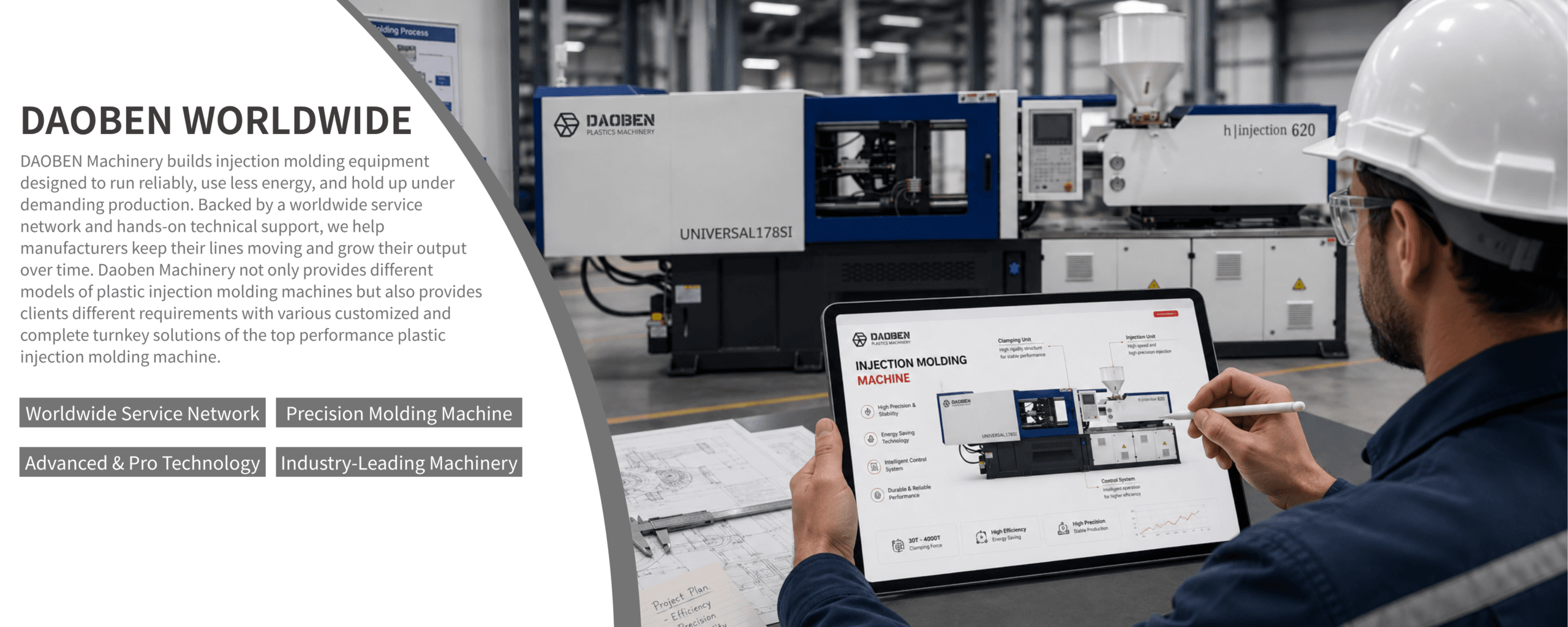
Servo drives are a big reason modern machines save power. Daoben’s servo-driven UNIVERSAL series, for instance, cuts energy use sharply versus fixed-pump systems. Lower energy per cycle means lower cost per part — and that adds up fast at volume.
Are Chinese Machines Really Cheaper?
Yes, and by a wide margin. Per July 2026 industry data, high-end Chinese machines cost 20–25% less than European and American models. Mid-range machines run 30–35% cheaper.
This is not just a brand discount. It reflects real differences in how core parts are sourced and built. For scale, the average high-end all-electric machine exported from Europe to Asia costs about €480,000. That is roughly 3.2 times the price of a comparable Chinese export.
For small and mid-size factories, that saving matters. You get solid quality without the premium price. Daoben, for example, builds machines from 30 to 4,000 tons, so buyers can match tonnage to the job without overpaying.
Which Offers Better Service and Support?
Here Chinese suppliers hold a natural edge on speed and cost. Haitian, for example, runs a wide local network. So response times stay quick, spare parts are easy to get, and line planning stays simple.
European brands offer strong global service too. But local spare parts can cost more. Technical visits often need scheduling in advance, which can stretch response times.
Where Is the Market Heading?
Chinese exports keep climbing. In 2024, exports hit US$2.089 billion, and the trade surplus grew to US$1.652 billion. Chinese brands are strong in Southeast Asia, India, and Turkey. They are also gaining ground in Europe.
Meanwhile, European makers face high energy costs and softer orders. Some are shifting to regional production to cut costs and speed up delivery.
Chinese or European: Which Should You Buy?
It depends on your parts, your budget, and your service needs. This simple guide can help:
- Choose European if you make micro, medical, or optical parts that need the tightest tolerances.
- Choose Chinese if you want strong quality, faster delivery, and lower cost for high-volume or mid-to-high-end work.
- Weigh total cost of ownership, not just the sticker price. Factor in energy, spare parts, and support over the machine’s life.
For many buyers today, a Chinese machine hits the sweet spot of quality, speed, and value.
Frequently Asked Questions
Are Chinese injection molding machines good quality?
Yes. Top Chinese brands now deliver reliable precision, servo energy savings, and long service life. They hold repeatability around ±0.005–0.01 mm, which suits most standard parts. For ultra-high precision, European machines still lead.
Why are Chinese machines cheaper than European ones?
Lower cost comes from local sourcing, large-scale production, and in-house parts — not just a smaller brand premium. High-end Chinese machines run 20–25% less than European models, and mid-range machines 30–35% less.
Do Chinese brands offer all-electric machines?
Yes, and adoption is rising fast. By 2025, Haitian’s MA all-electric series reached about 18% of the global market, up from 12% in 2022.
Which is better for medical or optical parts?
European machines are the safer pick for micro parts that need tolerances near ±0.0005 mm. For standard medical housings and many electronics parts, quality Chinese machines work well.
How much can I save by buying Chinese?
Expect to save 20–35% versus comparable European machines. A high-end European export to Asia averages about €480,000 — roughly 3.2 times a similar Chinese machine.
Is after-sales service faster with Chinese suppliers?
Often yes, especially for local parts and quick response. European brands offer global coverage, but parts and scheduled visits can cost more and take longer.
The Bottom Line
European injection molding machines still lead on precision, stability, and smart controls. So they remain the top choice for the most demanding, high-end work. Chinese machines counter with lower cost, faster delivery, and strong local support — and the quality gap keeps closing.
The right pick comes down to your product needs and budget. Want help matching a machine to your parts? Explore Daoben’s full range or reach out for a quick quote.