A 200 ton injection molding machine sits at one of the most active tonnage points in the global market. It handles a wide range of mid-size plastic parts — from automotive components and household fittings to medical device housings and packaging containers. Because 200 ton machines are versatile, the market is crowded with options at very different quality and price levels.
That range makes buying decisions harder, not easier. A machine quoted at $19,000 and one quoted at $45,000 can both carry the same clamping force label. The difference lies in drive system, control quality, injection speed, energy consumption, and long-term reliability. Choosing on price alone is how processors end up with machines that can’t hold shot weight tolerances or need unplanned maintenance every three months.
Daoben Machinery manufactures injection molding machines from 30 Ton to 4,000 Ton. Our 200 Ton servo-hydraulic machines are among our most ordered models, used by producers across Europe, Southeast Asia, the Middle East, and Latin America. This guide covers every buying variable that matters — specs, price ranges, drive systems, applications, and what to check before you sign a purchase order.
Quick Answer: A 200 ton injection molding machine has a clamping force of 200 metric tons (1,962 kN) and suits mid-size parts with projected areas up to approximately 300–350 cm². In 2026, prices range from $18,000 for standard hydraulic models to $80,000 for all-electric servo machines. Servo-hydraulic models in the $26,000–$42,000 range offer the best balance of cost, speed, and energy efficiency for high-volume production.
What a 200 Ton Injection Molding Machine Can and Cannot Do
Clamping force determines how large and how complex a part the machine can produce without mold separation during injection. At 200 tons, the machine covers a broad range of mid-size parts — but it has limits. Understanding those limits prevents costly mismatches between machine and mold.
The projected area rule is the key constraint. Injection pressure pushing against the mold cavity creates a separating force. The clamping force must exceed that force to keep the mold closed. For most standard materials — PP, ABS, HDPE, PC — a 200 ton machine can safely mold parts with a projected area up to approximately 300–350 cm². High-viscosity materials like PC/ABS blends or glass-filled nylon reduce that ceiling.
Typical Parts Produced on 200 Ton Machines
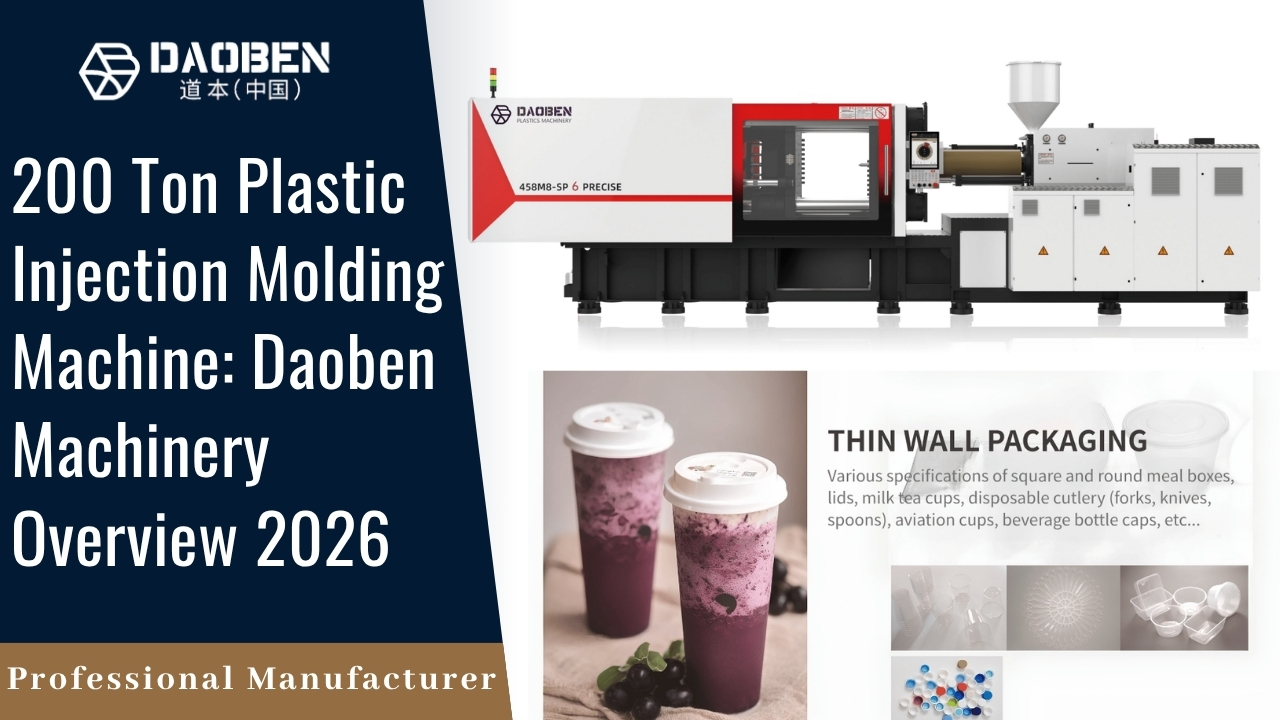
Common applications include: automotive interior brackets and clips, household appliance housings (fans, small appliances), medium-size food containers (1–3 litre), plumbing fittings and connectors, electronic enclosures, and cosmetic packaging components. Multi-cavity molds for smaller parts — such as 4-cavity bottle caps or 8-cavity connector housings — also run efficiently at this tonnage.
What this machine does not handle well: large flat panels above 350 cm² projected area, structural parts requiring more than 1,800 bar sustained injection pressure across wide cavities, or single-cavity molds for 10-litre-plus containers. Those applications move into 300–500 Ton territory. If you are building a production line and need guidance on where 200 Ton ends and larger machines begin, the 2025 injection molding machine price guide covers cross-tonnage comparisons in detail.
Shot Volume and Material Compatibility
A 200 ton machine typically offers shot volumes between 350 and 520 cm³ depending on screw diameter — usually 40 mm, 45 mm, or 50 mm options. PP and HDPE are the easiest materials at this tonnage. ABS, PC, PA6, and PA66 all run well with appropriate barrel temperature control. Flame-retardant grades and glass-filled resins require wear-resistant screw and barrel configurations, which reputable suppliers offer as a factory option.
200 Ton Injection Molding Machine: Core Technical Specifications
Before comparing suppliers, establish the full specification baseline. Clamping force is just one number. Shot volume, injection speed, platen size, and dry cycle time are equally important — and these vary between manufacturers even at the same nominal tonnage.
| Specification | Typical Range | Notes |
| Clamping Force | 200 Ton (1,962 kN) | Verified at 0% tolerance by load cell |
| Shot Volume | 350 – 520 cm³ | Depends on screw diameter selected |
| Injection Pressure | 1,400 – 1,800 bar | Higher end for thin-wall parts |
| Injection Speed | 120 – 220 mm/s | Servo models reach upper range |
| Dry Cycle Time | 1.8 – 2.8 seconds | Servo-hydraulic at lower end |
| Tie-Bar Spacing | 470 × 470 mm (typical) | Varies by manufacturer |
| Platen Size | 700 × 680 mm (typical) | Verify against your mold footprint |
| Motor Power | 11 – 22 kW | Servo uses 35–50% less than hydraulic |
These figures represent typical ranges across reputable manufacturers. Budget-tier machines often compromise on injection speed, platen stiffness, and control system accuracy. Always request a full technical data sheet (TDS) from the supplier and verify that the clamping force is measured at the platens — not estimated from hydraulic pressure alone.
Daoben’s 200 Ton servo-hydraulic machines in the M8SII series meet or exceed all of the above figures. Dry cycle time runs at 2.1 seconds in standard servo configuration, and injection speed reaches 220 mm/s with the high-speed injection option. Both specifications are factory-verified before shipment.
200 Ton Injection Molding Machine Price Range in 2026
Price for a 200 ton machine in 2026 varies significantly by drive system, country of manufacture, control system quality, and after-sales support package. Chinese manufacturers dominate the lower and mid-price segments. European brands — including Engel, Arburg, and Krauss-Maffei — occupy the premium tier. Taiwanese and South Korean manufacturers sit between the two.
| Machine Type | Drive System | Price Range (USD) | Best Application |
| 200 Ton Standard | Conventional Hydraulic | $18,000 – $28,000 | General molding, low-speed parts |
| 200 Ton Servo | Servo-Hydraulic | $26,000 – $42,000 | High-volume, energy-sensitive production |
| 200 Ton Hybrid | Servo + Hydraulic Boost | $38,000 – $55,000 | Fast cycle, precision mid-size parts |
| 200 Ton All-Electric | Full Electric Servo | $50,000 – $80,000 | Medical, food-grade, clean-room |
These price ranges reflect EXW (ex-works) factory pricing. Add freight, import duties, installation, and commissioning to reach total landed cost. For buyers in Southeast Asia, Middle East, or Africa, landed cost typically adds 8–18% to EXW price depending on destination and shipping route.
The servo-hydraulic segment at $26,000–$42,000 is where most volume buyers land in 2026. Energy savings from servo motors versus conventional hydraulic systems typically reach 35–50% reduction in power consumption. On a machine running three shifts, that saving often recoups the price premium within 12–18 months of operation. Published analysis of automated injection molding economics supports this payback range for servo drive adoption.
What Drives Price Differences Between Brands
Control system quality is the single biggest differentiator below the surface. Entry-level machines often use basic PLCs with limited data logging and no remote diagnostic capability. Mid-tier machines use proprietary HMI systems with production monitoring. Premium machines offer Industry 4.0 connectivity, SPC (Statistical Process Control) data output, and integration with MES (Manufacturing Execution Systems).
Platen rigidity also matters. Cheaper machines use thinner platens that flex under load — causing uneven clamping pressure across the mold and accelerating wear on the mold’s parting surface. This problem rarely shows up on a factory visit; it shows up after 500,000 cycles when your mold starts producing flash in one corner. Reputable manufacturers publish platen deflection data; ask for it.
For a structured comparison of leading brands across these criteria, the top 10 injection molding machine brand comparison covers key differentiators between Chinese, Taiwanese, and European manufacturers at the 200 Ton level.
Servo-Hydraulic vs All-Electric: Which 200 Ton Machine Fits Your Production
Drive system selection is the most consequential decision in the buying process after confirming tonnage. It affects energy cost, cycle time, maintenance schedule, and clean-room compatibility. Each drive type has a clear use case — and a clear case against it in the wrong application.
Servo-Hydraulic: The Mainstream Choice for 200 Ton Production
Servo-hydraulic machines use a variable-speed servo motor driving a fixed hydraulic pump. The servo motor runs only when the machine demands movement — unlike conventional hydraulic machines where the pump runs continuously. This design delivers 35–50% energy savings versus conventional hydraulic, fast pressure response, and lower oil temperature — which extends hydraulic oil life and reduces cooling water consumption.
For most 200 ton applications — packaging, automotive, general industrial — servo-hydraulic is the correct choice. It handles multi-cavity tooling well, tolerates some variation in material batch quality, and costs significantly less than all-electric at this tonnage. Maintenance is straightforward for any engineer familiar with hydraulic systems.
All-Electric: When It Justifies the Premium
All-electric 200 ton machines use servo motors for every axis — clamping, injection, screw plasticising, and ejection. There is no hydraulic oil, which means no oil contamination risk and minimal heat generation. These machines suit medical device production, food-contact applications, and clean-room environments where ISO 14644 Class 7 or Class 8 requirements apply.
The trade-off is cost and sensitivity. All-electric machines at 200 Ton typically cost $50,000–$80,000 — a 25–40% premium over comparable servo-hydraulic models. They also require a stable power supply and clean operating environment. In dusty or humid factory conditions, all-electric machines need more protection and more careful maintenance than servo-hydraulic equivalents.
Conventional Hydraulic: Still Viable in Low-Volume Settings
Standard hydraulic 200 ton machines remain in production and carry the lowest purchase price — $18,000–$28,000. For low-volume production (under 200,000 cycles per year), infrequent operation, or applications where energy cost is secondary, a conventional hydraulic machine can still make commercial sense. However, for any production running more than one shift per day, the servo-hydraulic option pays back its premium too quickly to justify the conventional alternative.
200 Ton Injection Molding Machine Applications Across Industries
A 200 ton machine serves a wider application range than most other tonnage points. Its combination of medium projected area capacity, flexible shot volume, and manageable footprint makes it the workhorse of mid-size plastic component production globally.
Automotive: Interior trim components, HVAC vents, sensor brackets, connector housings, and fluid reservoir caps. ABS, PP, and PA66 are the dominant materials. Multi-cavity tooling is common — 4-cavity or 8-cavity setups for connector components push part output per hour above 1,000 units.
Packaging: Medium-size containers (500 ml to 3 litre), closure caps, thin-wall food containers with IML (In-Mold Labelling) tooling, and tamper-evident packaging components. Thin-wall packaging at this tonnage requires high-speed injection — verify the machine reaches at least 200 mm/s injection speed before specifying for thin-wall applications.
Household and appliance: Fan housings, vacuum cleaner components, small appliance covers, kitchen tool handles, and electrical box enclosures. ABS and PP dominate. These parts often require good cosmetic surface quality, so machines with stable screw back pressure control and consistent melt temperature perform better than those with basic temperature management.
Medical and diagnostics: Single-use diagnostic device housings, pipette components, and non-implant medical enclosures. These applications drive all-electric machine selection at 200 Ton. Material traceability requirements (ISO 13485 compliance) are common in this sector, so machine control systems must support full parameter logging per production batch.
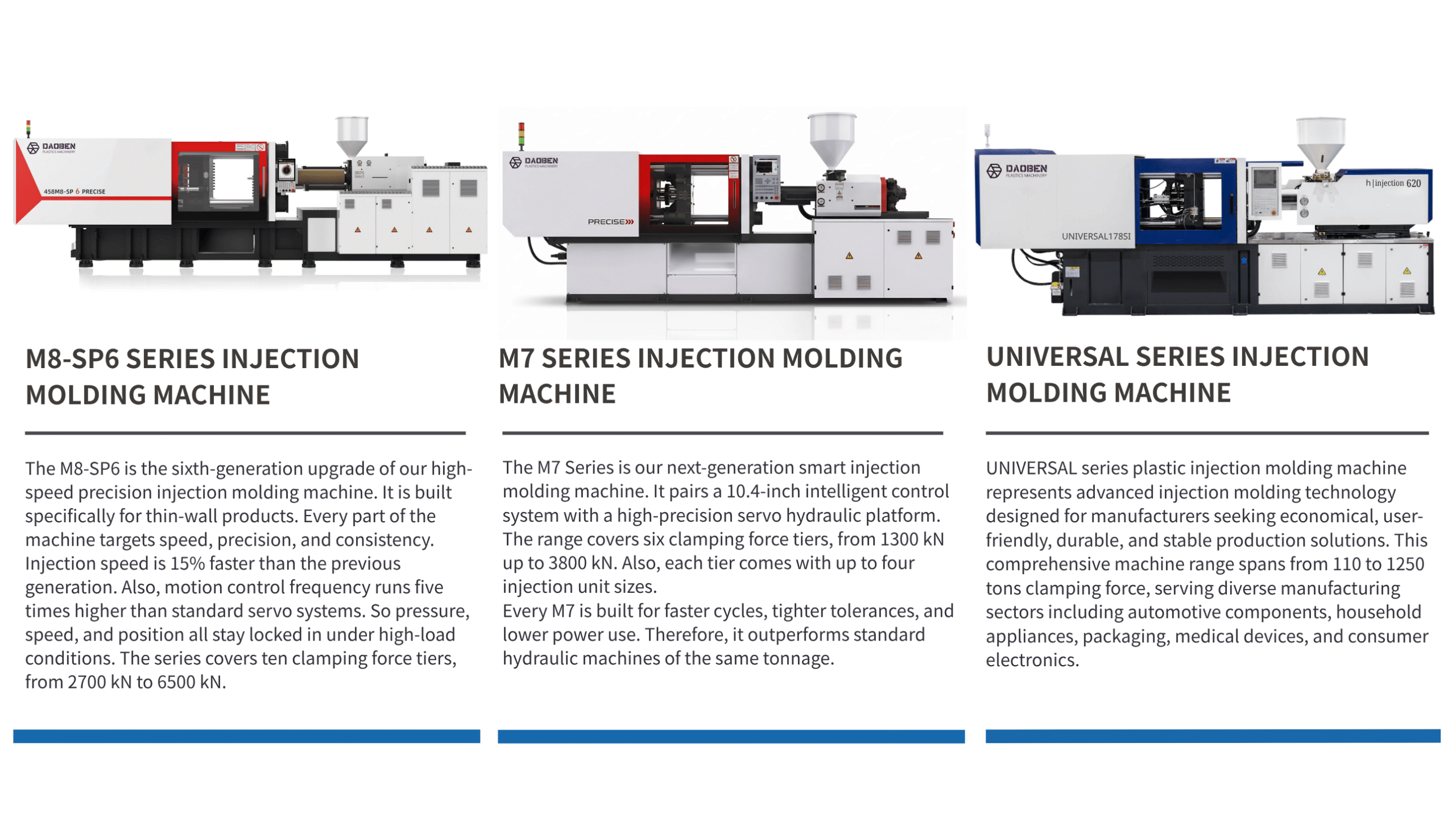
Producers running high-mix product portfolios — switching molds frequently across different product families — benefit from Daoben’s Universal series at 200 Ton, which offers wider tie-bar spacing than standard models. This configuration fits a broader range of mold footprints without mechanical adjustments.
200 Ton Injection Molding Machine: What to Check Before You Buy
Every supplier can produce an impressive brochure. The verification happens in the technical data, the factory, and the after-sales terms. Work through this checklist before committing to any supplier.
Machine Verification Points
Clamping force verification: Request the factory test report showing clamping force measured by calibrated load cell — not calculated from cylinder pressure. This is standard practice among reputable manufacturers and should take less than 24 hours to provide.
Injection speed curve: Ask for the actual injection speed profile at 200 mm/s setting, measured with a displacement sensor. This reveals whether the machine reaches peak speed smoothly or overshoots — a sign of poor servo tuning.
Control system demonstration: Request a screen recording or live demonstration of the HMI during a production run. Check that shot weight data is logged per cycle, that alarms have clear diagnostic messages, and that parameter adjustments take effect in real time.
Energy consumption data: Ask for power consumption in kWh per kilogram of output, measured on a representative application. Servo-hydraulic machines should show 0.35–0.55 kWh/kg on standard PP parts.
Supplier Verification Points
Spare parts lead time: Ask specifically about lead time for critical components: servo motor, hydraulic pump, barrel and screw assembly, control board. A supplier with a 90-day lead time on a servo motor is a production risk.
Installation and commissioning: Confirm whether the supplier provides an engineer for machine commissioning at your site, or whether installation is self-managed. First-time buyers in particular benefit enormously from supplier-led commissioning — it shortens ramp-up time by weeks in most cases.
Warranty terms: Standard industry warranty for Chinese manufacturers is 12–18 months on machine components, excluding consumables. Clarify whether the warranty covers on-site repair or return-to-factory repair, and who pays freight on warranty claims.
Daoben Machinery provides full technical documentation, factory acceptance testing, and on-site commissioning support for customers who require it. Our injection molding machine range is available to review with technical specifications for each model series.
Frequently Asked Questions
How much does a 200 ton injection molding machine cost in 2026?
A 200 ton injection molding machine costs between $18,000 and $80,000 in 2026, depending on drive system and brand. Conventional hydraulic models start at $18,000–$28,000. Servo-hydraulic machines — the most widely purchased type — range from $26,000 to $42,000. All-electric 200 ton machines for medical and food-grade applications typically price from $50,000 to $80,000.
What is a 200 ton injection molding machine used for?
A 200 ton injection molding machine is used to produce mid-size plastic parts with projected cavity areas up to approximately 300–350 cm². Common applications include automotive interior fittings, household appliance housings, food containers (500 ml to 3 litre), plumbing components, and multi-cavity tooling for smaller parts like bottle caps and connector housings.
Is servo-hydraulic better than all-electric for a 200 ton machine?
Servo-hydraulic is the better choice for most 200 ton applications because it costs 25–40% less than all-electric and delivers 35–50% energy savings versus conventional hydraulic. All-electric 200 ton machines are better when the application demands oil-free environments, such as medical device or food-contact production. For general industrial and packaging production, servo-hydraulic offers superior value.
What shot volume does a 200 ton injection molding machine support?
A 200 ton injection molding machine typically supports shot volumes between 350 and 520 cm³, depending on the screw diameter selected (usually 40 mm, 45 mm, or 50 mm). The correct screw size depends on part weight and material. For PP parts weighing 80–200 grams, a 45 mm screw with a shot volume around 420 cm³ covers most applications comfortably.
How do I compare 200 ton injection molding machine brands?
Compare brands using five criteria: injection speed (verify measured, not theoretical), platen rigidity (ask for deflection data), control system quality (request a live demo), energy consumption per kilogram of output, and spare parts lead time. A structured comparison of top injection molding machine brands is a useful starting point before approaching suppliers directly.
What is the tie-bar spacing on a standard 200 ton machine?
Tie-bar spacing on a standard 200 ton injection molding machine is typically around 470 × 470 mm, though this varies between manufacturers by 20–40 mm in each direction. Tie-bar spacing defines the maximum mold width that fits between the bars. Always verify your mold’s footprint against the supplier’s exact tie-bar spacing before ordering — not against nominal industry averages.
Choosing a 200 Ton Machine Is a Five-Year Decision, Not a One-Time Purchase
A 200 ton injection molding machine runs for 10–15 years in normal production conditions. The machine you buy in 2026 will still be running in 2035 if maintained correctly — or will be a source of constant downtime and repair costs if it was underspecified from the start. That reality changes the calculation significantly.
Total cost of ownership — energy consumption, maintenance, downtime, and spare parts — routinely exceeds purchase price over a 10-year period. A servo-hydraulic machine that costs $12,000 more than a conventional hydraulic model at purchase can easily save $30,000–$50,000 in energy costs over its operating life. Factor that in when you compare quotations.
Daoben Machinery supplies 200 Ton machines across the M8SII and M7 series, with servo-hydraulic and hybrid configurations to match different production profiles. Our machines are CE-certified, built to ISO 9001 quality management standards, and supported by a global spare parts and service network. We work with customers to match machine specification to mold, material, and output requirements — not just to shift a unit.
To get a specification and quotation tailored to your application, visit our injection molding machine product range or contact the Daoben technical team directly. Buyers evaluating multiple tonnage options can also review our plastic crate and mid-size container machine guide for context on how 200 Ton machines compare to adjacent tonnage classes for similar applications.