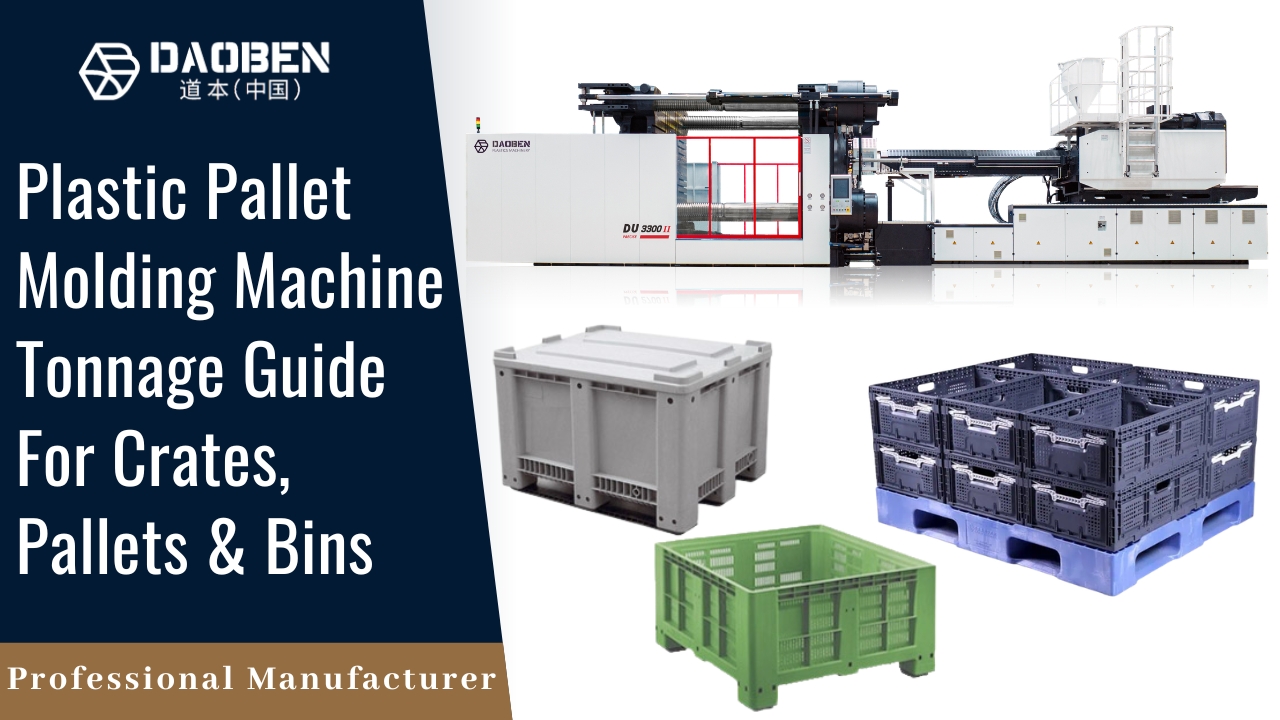
A plastic pallet molding machine has to clamp against far more force than a standard consumer-product press. Pallets, crates, and large bins carry thick walls, deep ribbing, and big projected areas, all of which push clamp tonnage into the hundreds or thousands of tons. Getting this number wrong is expensive, because underpowered machines flash on every shot and oversized machines waste capital and energy.
Logistics operators now depend on plastic pallets more than ever, because they are lighter, more durable, and easier to sanitize than wood. But that shift only works if the molding equipment behind it is sized correctly for the mold, the wall thickness, and the stacking loads the finished part must survive.
This guide walks through tonnage ranges for pallets, crates, and industrial bins, explains why stackable design changes machine requirements, and compares toggle versus two-platen clamping for large-part production.
Quick Answer: A plastic pallet molding machine typically requires 650 to 4,000 tons of clamping force, depending on pallet size, wall thickness, and rib design. Crates and smaller bins can run on 400 to 1,000 ton presses, while full-size logistics pallets with reinforced decks often need two-platen machines above 1,000 tons for consistent, flash-free production.
Why Pallets and Crates Need High-Tonnage Injection Molding
Pallets and crates are structural parts, not cosmetic ones. They carry stacking loads of 1.5 to 2 meters in warehouse racking and repeated forklift handling, so wall thickness and rib geometry are built for strength first. That thickness translates directly into a larger projected area, and larger projected area means more clamp tonnage to hold the mold shut during injection.
A crate injection molding machine also needs strong shot capacity, not just tonnage. Thick-walled parts require large shot volumes to avoid voids and sink marks, so the injection unit has to keep pace with the clamp. A machine with high tonnage but undersized shot capacity will still produce inconsistent, weak crates.
How Stackable Design Changes Machine Requirements
Stackable crates rely on interlocking tabs and recesses that must hold tight dimensional tolerances across every cycle. If clamping force is inadequate, the mold shifts slightly under pressure and those stacking features drift out of spec. Since stacking failures show up months later in a warehouse, not on the production line, underpowered tonnage is a risk that is easy to miss until it becomes expensive.
Plastic Pallet Injection Molding Tonnage by Part Type
Standard export pallets, roughly 1200 x 1000mm, commonly need 1,300 to 2,500 tons of clamping force depending on deck thickness and rib pattern. Smaller stacking crates for produce or retail distribution run lower, often between 650 and 1,000 tons. Large industrial bins and pallet boxes above 1,000 liters can require 2,500 tons or more, especially when reinforced with steel inserts or thick structural ribs.
Micro-foaming technology is increasingly used in pallet production to reduce shot weight and part deformation while keeping strength intact. This does not lower tonnage requirements by much, but it does improve dimensional stability across long production runs, which matters when a pallet has to nest and stack reliably at scale.
Plastic Crate Injection Molding vs. Large Container Molding Machines
Plastic crate injection molding and large container molding overlap, but they are not identical. Crates are typically shorter, lighter, and produced in higher cavity counts for logistics turnover, while large containers, drums, and pallet boxes are usually single or dual-cavity due to their size. So a crate line optimizes for speed and cavity count, while a container line optimizes for shot volume and cooling uniformity.
Daoben’s plastic crate injection molding machine line is built for this exact distinction, offering clamp configurations suited to stackable crate geometry without over-specifying tonnage for parts that do not need it.
Toggle vs. Two-Platen Machines for Pallet and Crate Production
Toggle machines handle tonnage up to roughly 900 to 1,100 tons efficiently, but beyond that range, the toggle linkage adds significant length behind the moving platen. Two-platen machines replace the toggle with direct hydraulic tie-bar locking, cutting overall machine length by up to 30 percent at the same tonnage.
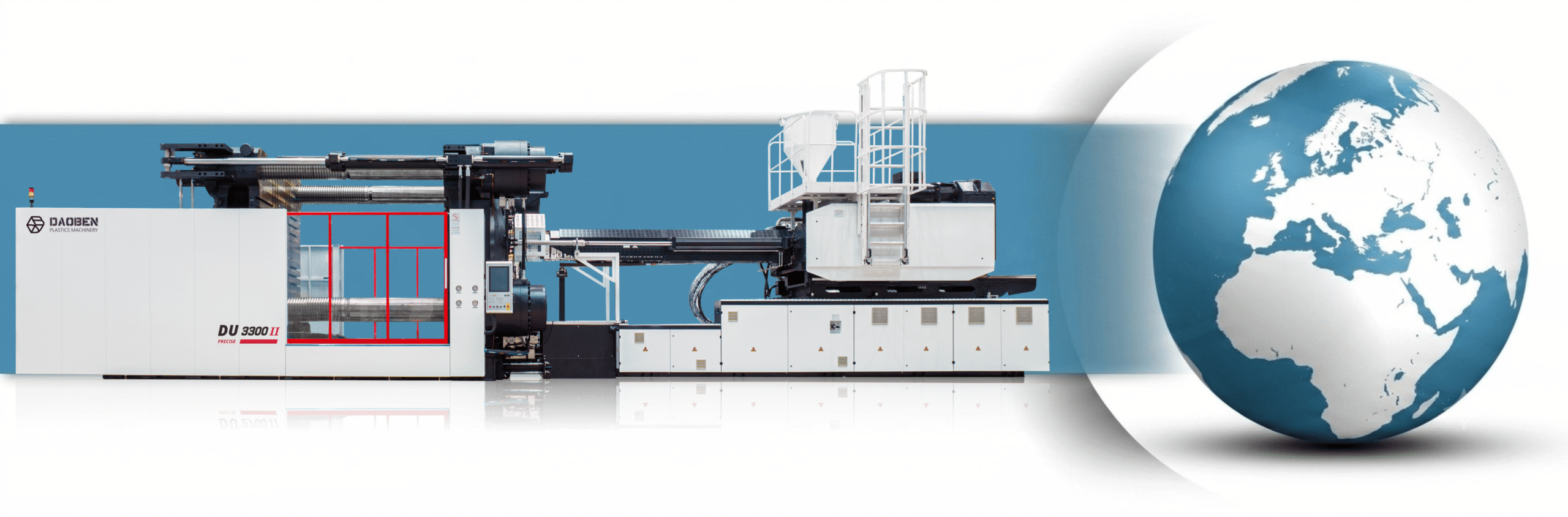
For pallets, crates, and bins above 500 tons, two-platen design is generally the better fit because the full platen face stays usable for mold mounting, without a toggle mechanism limiting mold size. Daoben’s DU Series two-platen injection molding machine uses independent tie-bar adjustment on all four bars, which keeps clamp force even across large, asymmetric pallet molds and reduces flash on visible surfaces.
Independent tie-bar adjustment matters more on pallet molds than on almost any other part type, because pallet cavities are large and often off-center relative to the platen. Uneven clamp force across a mold that size shows up as warping or flash on one side only, which is a difficult defect to trace back to tonnage distribution without the right diagnostic tools.
Shot Capacity and Injection Unit Sizing for Large Parts
Clamp tonnage gets most of the attention in pallet and crate sourcing conversations, but injection unit capacity deserves equal scrutiny. A large pallet mold might need a single shot of several kilograms, and if the injection unit cannot deliver that volume in one continuous shot, the part will show weld lines, inconsistent density, or visible flow marks across the deck surface.
Screw diameter and L/D ratio both affect how consistently a machine can plasticize large shot volumes. A longer L/D ratio generally improves melt homogeneity on thick-section parts, which matters more for pallets than for small consumer parts because pallet walls and ribs vary significantly in thickness across a single mold.
Buyers evaluating machines for pallet or bin production should request the maximum single-shot capacity in cubic centimeters or grams, not just tonnage, and compare that figure directly against the mold’s calculated total shot weight including runners. This prevents a mismatch between a machine that has plenty of clamping force but not enough injection volume to fill the mold properly in one continuous shot.
Material and Cycle Time Considerations for Large-Part Molding
Polypropylene and high-density polyethylene dominate pallet and crate production because both resist repeated flexing and impact without cracking. PP is generally preferred for lighter stacking crates, while HDPE suits pallets that need higher rigidity under sustained load in cold storage or outdoor environments.
Cycle times for large pallets run considerably longer than small parts, often 60 to 140 seconds per shot, because thick sections need more cooling time to solidify evenly. Cutting cooling time too aggressively to chase cycle speed usually backfires, producing warped decks that fail stacking tests. According to a TechBullion report on automated injection systems, automated cooling and process monitoring reduce per-unit costs primarily by cutting scrap rather than by shortening cycles artificially.
| Part Type | Typical Tonnage | Typical Cycle Time | Recommended Clamp Type |
| Stacking crate | 650–1,000 tons | 35–60 sec | Toggle or two-platen |
| Retail/logistics pallet | 1,300–2,500 tons | 60–100 sec | Two-platen |
| Industrial bin / pallet box | 2,500–4,000 tons | 90–140 sec | Two-platen |
| Small parts tray/tote | 400–650 tons | 25–40 sec | Toggle |
Common Mistakes When Sourcing High-Tonnage Pallet Equipment
The most frequent mistake is sizing tonnage from the pallet’s overall dimensions instead of its true projected area and rib design. Two pallets with the same footprint can require very different clamping force if one has significantly deeper ribbing or thicker structural sections, so a generic size-based estimate often under-specifies the machine.
A second common mistake is underestimating shot capacity relative to tonnage. Large pallets and bins need proportionally large shot volumes, and a machine with adequate clamping force but insufficient injection unit capacity will still produce inconsistent wall thickness or voids in thick sections. Both numbers need to be checked against the specific mold, not assumed from tonnage class alone.
Buyers should also ask how a manufacturer verifies clamp force distribution before shipping. On large, asymmetric pallet molds, uneven tonnage across the platen face is difficult to spot without a dedicated test, and it typically does not show up as a defect until the machine is already running full production volumes. Requesting documented commissioning tests, not just rated specs, closes this gap before it becomes a costly field problem.
Frequently Asked Questions
What tonnage is needed for a plastic pallet molding machine?
Standard export pallets typically need 1,300 to 2,500 tons of clamping force, while larger industrial pallets and reinforced decks can require up to 4,000 tons. The exact figure depends on projected area, wall thickness, and rib design across the mold.
Can a toggle machine produce plastic pallets?
Toggle machines can handle pallets up to around 900 to 1,100 tons, but beyond that range, two-platen machines are more practical because they avoid the space and clamp-distribution limits of a toggle mechanism at very high tonnage.
How long is the cycle time for a plastic crate injection molding machine?
Crate cycle times generally range from 35 to 60 seconds per shot, depending on wall thickness and cooling channel design. Thicker structural crates run closer to the higher end of that range to avoid warping.
What material is best for plastic pallets and crates?
Polypropylene and HDPE are the standard choices. PP suits lighter stacking crates well, while HDPE is preferred for pallets that need higher rigidity under heavy or sustained warehouse loads.
Why do large pallet molds need two-platen machines?
Two-platen machines provide even clamp force across large, often asymmetric mold faces without a toggle mechanism restricting usable platen area. This reduces flash and warping risk on big structural parts like pallets and bins.
Matching Machine Tonnage to Real Production Loads
Sizing a plastic pallet molding machine correctly protects both product quality and capital investment. Undersized tonnage causes flash, warping, and stacking failures that surface only after the pallet reaches a warehouse. Oversized machines waste energy and floor space without adding any real production benefit.
Buyers moving from wood to plastic pallets for the first time often underestimate how different the sourcing conversation is compared to standard consumer-part molding. Wall thickness targets, stacking load requirements, and warehouse handling conditions all need to feed into the tonnage and mold conversation early, rather than being treated as afterthoughts once a machine is already selected.
Daoben builds machines from 30 to 4,000 tons, covering everything from small stacking crates to full-size industrial pallets and bins on the same manufacturing platform. Details on the complete tonnage range are available on the injection molding machine manufacturer and supplier page.
If your project involves large-format pallets, crates, or bins, reach out through the injection molding machine manufacturer and supplier page for tonnage and mold guidance built around your actual load specs.