Quick answer: The right plastic injection molding machine depends on four things: your part size, your yearly volume, your material, and your floor space. Small workshops usually need 30 to 160 tons. High-volume plants need servo hybrid or all-electric machines for lower energy use. Automotive work needs two-platen machines above 800 tons. Medical work needs all-electric machines built for cleanrooms.
Buying a molding machine is a ten-year decision. Get the tonnage wrong and you will flash every part. Get the machine type wrong and you will pay for it every month in power bills.
This guide walks through the whole choice. First we cover sizing. Then we compare machine types. After that, we look at six common buying situations, from a first workshop machine to a 2,000-ton automotive line.
Quick Pick: Which Machine Type Fits Your Work?
| Your situation | Machine type | Typical tonnage | Why |
|---|---|---|---|
| Prototypes and short runs | Servo hydraulic | 30–120T | Lowest upfront cost |
| Small workshop, first machine | Servo hydraulic | 60–160T | Simple to run and repair |
| Tight floor space | Vertical or two-platen | 30–90T or 500T+ | Smaller footprint |
| High-volume production | Hybrid or all-electric | 160–650T | Lower energy per part |
| Fast cycles, thin walls | Hybrid with accumulator | 160–450T | Higher injection speed |
| Automotive parts | Two-platen | 800–4,000T | Large mold, wide tie bars |
| Medical components | All-electric | 50–250T | Clean running, repeatable |
| Lowest running cost | All-electric | Any | No hydraulic oil |
Step 1: Work Out the Tonnage You Need
Tonnage means clamping force. It is the force that holds the mold shut while plastic fills the cavity. Too little force and the mold opens slightly, so you get flash.
The basic rule is simple. You need 2 to 5 tons of clamping force per square inch of projected part area.
Here is a worked example. Say you mold a plastic tray. The tray measures 10 inches by 8 inches, so the projected area is 80 square inches. You run polypropylene, which needs about 3 tons per square inch. So you need 240 tons. Then add 10 to 20% as a safety margin. A 280-ton machine suits the job.
Projected area means the shadow the part casts when you look straight down at the mold. Remember to add the runner system. Also multiply by the number of cavities.
Tons per square inch by material
| Material | Tons per sq in |
|---|---|
| Polyethylene (PE) | 2.0–3.0 |
| Polypropylene (PP) | 2.5–3.5 |
| ABS | 3.0–4.0 |
| Polycarbonate (PC) | 4.0–5.0 |
| Glass-filled nylon | 5.0–6.0 |
Thin-wall parts need more force, because the plastic fills faster and at higher pressure. Deep parts with thick walls need less.
Step 2: Pick the Machine Type
Four types dominate the market. Each one trades cost against energy and precision.
Standard hydraulic
An older design. A fixed pump runs all the time, even when the machine sits idle. These machines cost the least to buy. However, they use the most power, and they run hot.
Choose one only if you run few hours per week and your budget is very tight.
Servo hydraulic
The pump speeds up when the machine needs pressure. Then it slows down between shots. As a result, energy use drops by roughly 40 to 60% against a standard hydraulic machine.
This is the best value for most small and mid-size shops. Repairs stay simple. Parts stay cheap. Local technicians already know the system.
Hybrid
A hybrid uses an electric screw drive with hydraulic clamping. So you get fast, accurate injection plus strong clamping force. Cycles get shorter, and shot weight stays consistent.
Hybrids suit high-volume work and thin-wall packaging. They cost more than servo hydraulic, but they pay that back through output.
All-electric
Servo motors drive every movement. There is no hydraulic oil at all. Energy use drops by 50 to 70% against standard hydraulic machines. Shot-to-shot repeatability is the best of any type.
All-electric machines cost the most upfront. Still, they win on medical work, micro-molding, and any plant running three shifts.
| Hydraulic | Servo hydraulic | Hybrid | All-electric | |
|---|---|---|---|---|
| Purchase cost | Lowest | Low | Medium | Highest |
| Energy use | Highest | Medium | Low | Lowest |
| Repeatability | Fair | Good | Very good | Best |
| Cleanroom ready | No | Limited | Limited | Yes |
| Oil changes | Yes | Yes | Yes | None |
| Best for | Occasional use | Small and mid shops | High volume | Medical, precision |
Injection Molding vs CNC Machining: Which Suits Prototypes?
Many buyers ask this before they commit to a machine. The answer comes down to volume.
CNC machining cuts parts from solid blocks. There is no tooling cost, so your first part is cheap. But every part after that costs the same.
Injection molding needs a mold first. That mold might cost $3,000 for a simple prototype tool. After that, each part costs pennies.
The break-even point usually sits between 500 and 2,000 parts. Below that, CNC wins on cost. Above it, molding wins by a wide margin.
| Factor | CNC machining | Injection molding |
|---|---|---|
| Tooling cost | None | $3,000–$50,000+ |
| Cost per part | High, flat | Very low at volume |
| First part ready | 3–7 days | 3–6 weeks |
| Best volume | 1–500 | 1,000+ |
| Material choice | Limited to stock shapes | Almost any thermoplastic |
| Surface finish | Tool marks | Mold finish |
Many teams use both. They machine 50 parts for testing. Then they cut an aluminium bridge tool for 5,000 parts. Finally they move to steel tooling for full production.
Best Machines for Small-Scale Manufacturing
Small-scale means low volume and small parts. Think enclosures, caps, clips, and short-run consumer goods.
For this work, look at 30 to 160 tons. A servo hydraulic machine gives you the best balance of price and running cost.
Check these seven specs before you sign anything:
- Clamping force matched to your largest part, plus 15%
- Shot weight at least 30% above your part weight
- Tie-bar spacing wide enough for your mold base
- Mold height range, both minimum and maximum
- Injection rate for thin walls
- Connected power against what your building supplies
- Spare parts lead time from the supplier
That last point matters more than most buyers expect. A cheap machine with a six-week parts wait will cost you far more than the saving.
Buying Your First Machine: A Beginner’s Checklist
If this is your first machine, the machine price is only part of the bill.
Budget for the full setup:
- The molding machine
- The mold, which often costs more than the machine
- A material dryer, which is essential for nylon, PC, and ABS
- A water chiller or cooling tower
- A hopper loader
- A crane or forklift for mold changes
- Sea freight, import duty, and installation
Then check your building. Ask three questions. Do you have the right power supply and phase? Do you have cooling water? Is your ceiling high enough to lift a mold into place?
Questions to ask any supplier
- What is the warranty period, and what does it cover?
- Do you provide installation and operator training?
- Which parts are consumable, and what do they cost?
- Can you support us remotely when a fault appears?
- Can we run a factory acceptance test before shipping?
A good molding machine supplier answers all five without hesitation. Ask for video of your machine running before it leaves the factory.
Compact Machines for Limited Factory Space
Floor space costs money every month. So footprint deserves real attention.
The machine footprint on a datasheet is not the space you need. Add clearance for these:
- Mold change access on the operator side
- Safety gate swing
- The dryer, chiller, and loader
- An operator walkway of at least 1 metre
- Space in front for a parts bin or conveyor
As a rule, plan for roughly twice the machine footprint.
Two ways to save space:
First, consider vertical machines for small inserts and overmolding. They use a fraction of the floor area of a horizontal machine.
Second, look at two-platen designs at higher tonnages. A two-platen machine removes the long toggle housing at the back. That cuts overall length by around 15 to 20% against a comparable toggle machine. On a 1,000-ton machine, that is metres of floor recovered.
You can also stack auxiliaries. Mount loaders overhead. Put the chiller outside the production hall.
The Most Efficient Machines for High-Volume Runs
At high volume, small numbers turn into big money. A single second cut from a 15-second cycle adds roughly 5,700 extra parts per week on a 24-hour line.
So judge efficiency on four measures:
- Energy per kilogram of plastic processed
- Cycle time under real production conditions
- Uptime, meaning hours run against hours planned
- Scrap rate across a full shift
Hybrid and all-electric machines lead on the first two. Servo hydraulic machines close the gap on energy, but they rarely match electric machines on repeatability.
Multi-cavity tooling changes the maths too. An 8-cavity mold needs far more clamping force than a 2-cavity mold. Yet it drops your cost per part sharply. Work out the tooling plan first. Then size the machine around it.
Finally, plan for automation. A machine with a robot mount, a free ejector signal, and a Euromap interface will accept a take-out robot later without a rebuild.
How to Get Faster Cycle Times
A molding cycle has six stages. Cooling takes the largest share, usually 60 to 70% of total cycle time.
| Stage | Share of cycle |
|---|---|
| Mold close | 5% |
| Injection and pack | 15% |
| Cooling | 60–70% |
| Mold open | 5% |
| Ejection | 5% |
| Part removal | 5–10% |
That tells you where to focus. Cooling design in the mold beats almost any machine feature.
Machine features that do shorten cycles:
- High injection speed for thin walls
- An accumulator for burst injection pressure
- Servo drives that move platens faster
- Parallel movements, so the screw recovers while the mold opens
- Fast dry cycle time, which suppliers list on the datasheet
Typical cycle times by application:
| Application | Cycle time |
|---|---|
| Thin-wall containers | 3–7 seconds |
| PET preforms | 8–14 seconds |
| Caps and closures | 3–6 seconds |
| Automotive interior trim | 40–70 seconds |
| Thick-wall industrial parts | 60–120 seconds |
One warning. Cutting cooling time too far causes warpage, because the part leaves the mold before it stabilises.
Learn more how cooling design prevents warpage
Machines for Automotive Parts
Automotive molding means large parts, tight tolerances, and long production programmes.
Tonnage rises fast with part size:
| Part | Typical tonnage |
|---|---|
| Clips and connectors | 50–150T |
| Light housings | 350–650T |
| Door panels | 800–1,600T |
| Instrument panels | 1,600–2,500T |
| Bumpers | 2,500–4,000T |
Above roughly 800 tons, two-platen machines take over. They give wider tie-bar spacing for big molds. They also open further, which matters for deep parts. And they need less floor length.
Automotive buyers should also check three things. Ask whether the supplier holds IATF 16949 certification. Ask about shot-to-shot repeatability data, not just a spec sheet number. Then ask about support for gas-assist, two-shot, or overmolding if your programme needs it.
Programmes run for years. So parts availability and service response matter as much as the machine itself.
Machines for Medical Device Components
Medical work has the strictest requirements of any sector.
All-electric machines dominate here, and for good reason. They produce no oil mist. They hold shot weight within very tight limits. They also run clean enough for ISO 14644 cleanroom classes.
Look for these features:
- Encapsulated or stainless linear guides
- Smooth, wipeable surfaces with few ledges
- Low-particle drives and belts
- Top-mounted robot capability
- Clean-side and technical-side separation
Validation adds another layer. Your machine needs to support IQ, OQ, and PQ documentation. Ask the supplier what they provide for each stage.
Materials matter too. PC, PEEK, COC, and medical TPEs each place different demands on the screw and barrel. Confirm the screw design suits your resin before you order.
Daoben is ideal to cleanroom injection molding for medical and electronics buyers.
Which Machines Have the Lowest Maintenance Costs?
All-electric machines cost the least to maintain, because they have no hydraulic system at all.
Here is how annual maintenance compares on a mid-size machine running two shifts:
| Machine type | Annual maintenance |
|---|---|
| Standard hydraulic | Highest |
| Servo hydraulic | Medium |
| Hybrid | Medium to low |
| All-electric | Lowest |
The parts that fail most often:
- Screw and barrel wear, especially with glass-filled resins
- Non-return valve, or check ring
- Heater bands and thermocouples
- Hydraulic seals and hoses
- Toggle bushings and pins
Hydraulic oil deserves special mention. A 250-ton hydraulic machine may hold 300 to 500 litres. You change it every two to three years. Then you pay to dispose of it safely.
A simple maintenance schedule
- Daily: check oil level, water flow, and safety gates
- Weekly: clean filters, grease toggles, check heater readings
- Monthly: test oil quality, inspect hoses, check platen parallelism
- Yearly: inspect screw and barrel wear, replace worn seals
One point gets overlooked. Spare parts availability affects real cost more than build quality does. A machine down for three weeks costs far more than the part itself.
Total Cost of Ownership Over Ten Years
Purchase price is usually 20 to 30% of what a machine costs you across its life.
Add these up before you compare quotes:
- Purchase price and shipping
- Installation and training
- Electricity across ten years
- Hydraulic oil and disposal
- Spare parts and consumables
- Downtime, valued at your hourly output
- Scrap from poor repeatability
Run this simple calculation. Take your machine’s connected power. Multiply by your running hours. Multiply by your local electricity rate. An all-electric machine using 40% less power can save five figures a year on a three-shift line.
How Daoben Machines Fit These Needs
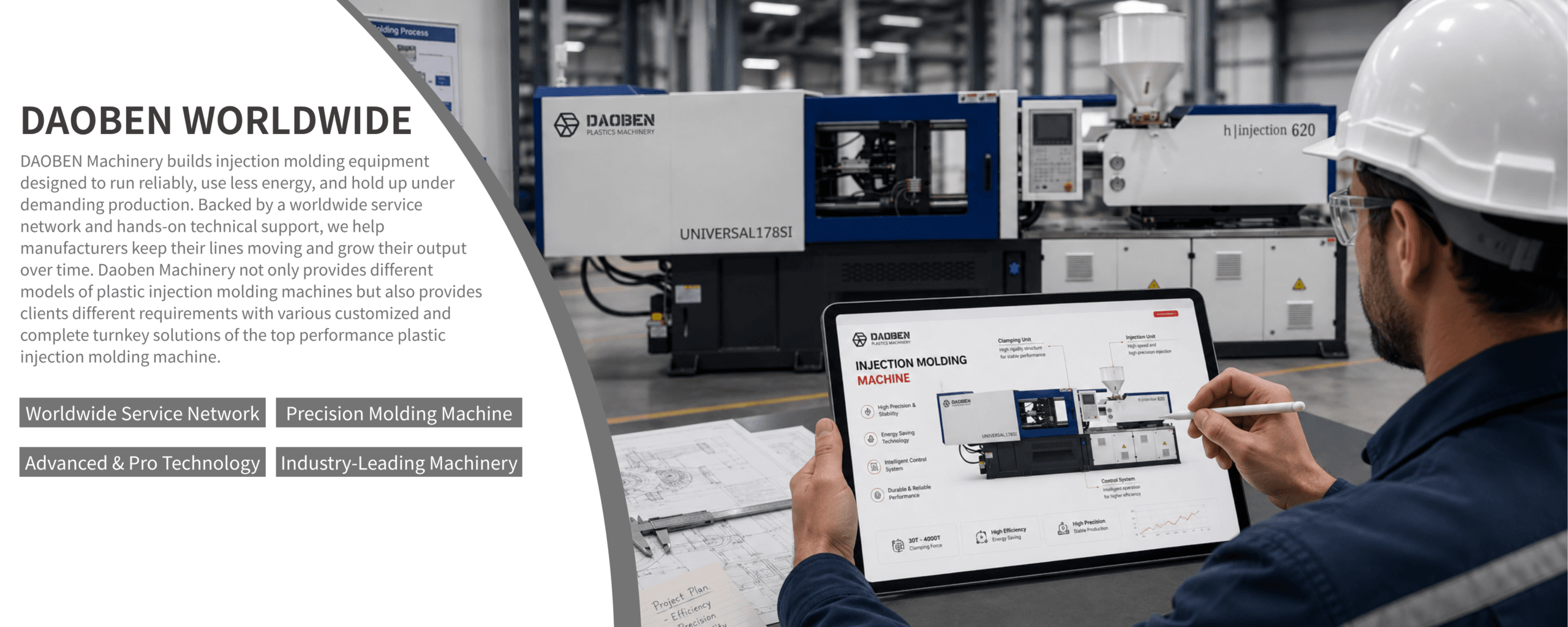
Daoben Machinery builds injection molding machines from 30 to 4,000 tons. The range covers every scenario in this guide.
- M7 and UNIVERSAL series: small and mid tonnage for workshops, prototypes, and general production
- M8SII and M8-SP6 series: production machines for consistent, higher-volume output
- EV Hybrid series: hybrid drive for lower energy use and shorter cycles
- PET series: built for preform and thin-wall work where cycle time decides profit
- DU two-platen series: high tonnage with a shorter footprint, suited to automotive and large industrial parts
Every machine ships with installation support, operator training, and remote diagnostics. Spare parts ship from stock.
FAQ
How many tons of clamping force do I need?
Multiply your part’s projected area in square inches by 2 to 5 tons, depending on the material. Then add 10 to 20% as a margin. A 100 square inch polypropylene part needs roughly 300 to 350 tons.
Is an all-electric machine worth the extra cost?
Yes, if you run two or three shifts. Energy savings of 50 to 70% usually repay the price difference within two to four years. For single-shift work, servo hydraulic often makes more sense.
What is the difference between a toggle and a two-platen machine?
A toggle machine uses a mechanical linkage to close the mold. A two-platen machine uses hydraulic cylinders on the tie bars. Two-platen machines are shorter and give wider mold space, so they suit tonnages above 800.
How long does an injection molding machine last?
A well-maintained machine runs for 15 to 20 years. The screw and barrel usually need replacing first, often after 5 to 8 years with abrasive materials.
Can I use one machine for different materials?
Yes, within limits. General-purpose screws handle PP, PE, ABS, and PS well. However, PVC, PET, and glass-filled resins need specific screw designs and barrel treatments.
What size machine should a small workshop start with?
Most small workshops start between 60 and 160 tons. That range covers enclosures, caps, clips, and small housings. Pick the size based on your largest planned part, not your smallest.
How much floor space does a molding machine need?
Plan for about twice the machine footprint. That covers mold change access, safety gates, auxiliary equipment, and an operator walkway.
What causes flash on molded parts?
Flash usually means not enough clamping force, worn mold faces, or injection pressure set too high. Check clamp force against your projected area first.
Ready to Size Your Machine?
Choosing well comes down to honest numbers. Know your part area, your yearly volume, your material, and your floor space. Then match the machine type to how many hours you plan to run.
Send us your part drawing and target volume. Our engineers will recommend a tonnage and machine series, with a full quotation, within 24 hours.