Quick answer: For most high-volume injection molding, servo-hydraulic machines offer the best balance of energy efficiency, part consistency, tonnage range, and cost — making them the default choice for large-scale factories. All-electric machines win for thin-walled, multi-cavity, and precision parts where speed and yield justify a 40–80% higher price. Choose by product type, tonnage, and total cost of ownership — not by unit price alone.
Key takeaways
- Servo-hydraulic is the best all-round choice for standard high-volume products, cutting energy use 30–45% versus traditional hydraulic machines.
- All-electric is the fastest and most precise option (±0.01 mm repeatability, 15–30% shorter cycles on thin-wall parts, 45–60% lower energy use) — ideal for thin-wall, medical, and multi-cavity work.
- Traditional fixed-pump hydraulic now suits only low-cost, large-tonnage, thick-wall jobs and has largely left mainstream mass production.
- Hybrid-drive is the middle ground for medium precision parts that still need heavy molds and high clamping rigidity.
- Decide on total lifecycle cost (electricity + scrap + downtime + spare parts), and require automation-readiness (fault alerts, parameter storage, robot and MES integration) for continuous 24/7 lines.
Large-scale, continuous injection molding prioritizes equipment stability, low failure rates, product consistency, and controllable operating costs — while also demanding automation integration. High-volume production is not about chasing the highest specification on the spec sheet; it calls for a considered evaluation across product type, tonnage range, and drive mechanism. The sections below break down the four mainstream machine categories, their strengths and trade-offs, and where each one fits.
Injection molding machine comparison for high-volume production
| Machine type | Energy vs. traditional hydraulic | Precision / repeatability | Cycle speed | Relative purchase cost | Best for | Not ideal for |
|---|---|---|---|---|---|---|
| Traditional fixed-displacement hydraulic | Baseline (highest use) | Moderate; drifts with oil temperature | Adequate for thick-wall parts | Lowest | Large, thick-wall, high-tonnage, tight budgets | Thin-wall, multi-cavity, precision |
| Servo-hydraulic | 30–45% lower | High; oil-temperature compensated | Good (below all-electric) | Low–moderate | Most general mass production, all tonnages | Ultra-fast thin-wall cycles |
| All-electric | 45–60% lower | Highest (±0.01 mm) | Fastest (simultaneous axes) | High (40–80% above servo-hydraulic) | Thin-wall, precision, medical, multi-cavity | Ultra-large tonnage, heavy parts |
| Hybrid-drive | Between servo-hydraulic and all-electric | Near all-electric injection + hydraulic clamp rigidity | Good | Moderate (below all-electric) | Medium precision parts needing heavy molds | Pure cost-minimization or maximum speed |
Traditional fixed-displacement hydraulic injection molding machines
What it is: A mature machine type in which a fixed-displacement oil pump delivers continuous pressure, with the full operating sequence controlled by a hydraulic valve assembly.
These machines are simple in construction, with high parts interchangeability, low maintenance complexity, and the lowest purchase price of any category. They can produce very high clamping forces and injection pressures, and high-tonnage models offer excellent rigidity — which makes them well suited to large, thick-walled products.
Advantages for mass production
- Robust and tolerant of harsh workshop conditions, with a wide accepted mold-weight range.
- Abundant spare parts, easy-to-hire maintenance staff, and short repair turnaround.
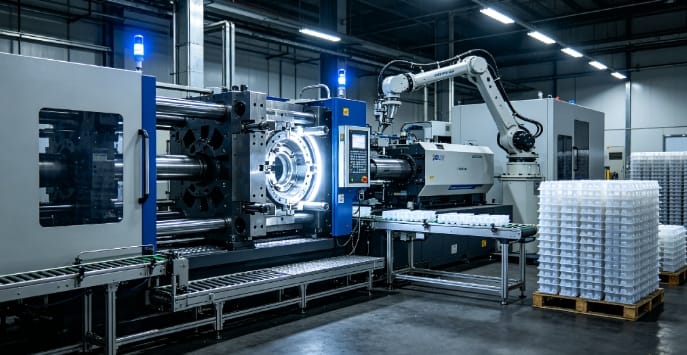
- For large, thick-walled items such as logistics crates and large housings — where cycle time is not limited by injection speed — they support continuous 24-hour production.
Drawbacks for mass production
- The pump runs continuously and draws significant power even during idle phases, so energy consumption is high.
- Hydraulic oil heats up over a production run, causing injection and holding pressures to fluctuate; this lowers batch-to-batch consistency and raises the scrap rate over long shifts.
- Hydraulic oil and seals need regular replacement, oil leakage and contamination are risks, and unplanned downtime is comparatively more likely.
Best for: High-volume orders of large-tonnage, thick-walled parts where budgets are limited, maintenance staff is plentiful, and energy cost is not a primary concern. Not suitable for large-scale thin-wall, multi-cavity, or high-precision production.
Servo-hydraulic injection molding machines: the mass-production mainstream
What it is: A hydraulic machine that keeps the hydraulic clamping and ejection structures but replaces the fixed-displacement pump with a servo-driven, variable-displacement pump system.
The motor outputs power only when the machine performs an action and slows during standby — an upgraded hydraulic system and the mainstay model for many large-scale factories. Mainstream domestic series such as the MA and HXM ranges belong to this category, with tonnages from a few dozen tons to over 3,000 tons.
Advantages for mass production
- Outstanding energy efficiency — energy use is 30–45% lower than traditional hydraulic machines, so in long-run production the electricity savings compound into substantial returns.
- Superior consistency — closed-loop pressure feedback minimizes the effect of oil-temperature swings, giving better part-weight and dimensional stability than traditional hydraulic machines and cutting the risk of batch scrap.
- Mature, affordable integration — procurement cost sits far below all-electric equipment, and integration with retrofits, robotic arms, and central material feeding is well established. The spare-parts supply chain is strong, technicians learn the machines quickly, and maintenance costs stay controllable.
- High rigidity at high tonnage — the hydraulically driven clamping unit gives high-tonnage models the strength for heavy molds and large products.
Drawbacks for mass production
- Hydraulic circuits remain, so hydraulic oil and seals still need regular maintenance and oil-leak risk persists.
- Multiple actions cannot be perfectly synchronized, and top cycle speed falls short of all-electric machines.
Best for: The vast majority of general plastic products — home-appliance components, automotive interior parts, everyday consumer goods, and plastic housings. Balancing cost, stability, and energy use, it offers the best overall value and is the preferred choice for most large-scale factories.
All-electric injection molding machines
What it is: A machine in which clamping, injection, ejection, and plasticizing are each driven by independent servo motors, eliminating hydraulic circuits entirely and transmitting power through ball screws.
Multi-axis synchronous motion is possible, with millisecond-level response and positioning repeatability of up to ±0.01 mm.
Advantages for mass production
- Shorter cycles — mold opening, ejection, and plasticizing can run simultaneously, cutting cycle time for small, thin-walled parts by 15–30% and raising output per hour, an edge that is especially pronounced with multi-cavity molds.
- Exceptional consistency — performance is unaffected by oil temperature, dimensional drift over long continuous runs is minimal, and yield is high.
- Best-in-class energy efficiency — 45–60% lower energy use than hydraulic models, with no hydraulic oil, keeping the workshop clean enough for medical and food-grade production.
- Lower maintenance — long lubrication-change intervals reduce upkeep.
Limitations for mass production
- High purchase price — 40–80% more than a servo-hydraulic machine at the same tonnage.
- Sensitive components — ball screws and servo drives require controlled dust and humidity; if core components fail, replacement is expensive and repairs are complex.
- Limited at very high tonnage — the technology cost for ultra-large all-electric machines is very high and market options are few, so they are unsuitable for massive, heavy-duty products.
Best for: Mass production of thin-walled packaging, precision electronic components, medical devices, and multi-cavity molds. Factories that prioritize high speed and high yield — and have the budget — typically favor small-to-medium tonnage all-electric machines.
Hybrid-drive injection molding machines
What it is: A balanced design that pairs an all-electric servo injection unit with a hydraulically driven clamping unit, combining the strengths of both.
Advantages for mass production
- Injection precision approaches that of all-electric machines, while the clamping unit keeps the high rigidity of hydraulic machines.
- Purchase price is lower than all-electric models.
- Well suited to products that need both high-precision injection and large-tonnage, heavy molds.
Limitations for mass production
- A hydraulic system is still present and needs maintenance.
- Energy efficiency sits between servo-hydraulic and all-electric machines.
Best for: Mass production of medium-sized precision structural parts where both clamping rigidity and injection precision matter.
How to choose an injection molding machine for high-volume production
Don’t evaluate on unit price alone — calculate the total lifecycle cost, including electricity, scrap losses, maintenance-downtime losses, and spare-parts cost. A simple decision path:
- Standard, general-purpose products → servo-hydraulic. It offers the best versatility, balancing capacity, stability, and investment cost.
- Thin-wall, multi-cavity, and precision small parts (output and yield are the priority, budget allows) → all-electric.
- Ultra-large, thick-walled parts → prioritize servo-hydraulic; select all-electric only with caution.
- Any machine type → high-volume production requires automation-readiness. Machines should provide fault early-warning and parameter storage so they connect cleanly to robotic arms, central material feeding, and MES platforms — minimizing manual intervention and enabling continuous 24-hour production.
FAQ: injection molding machines for high-volume production
What is the best injection molding machine for high-volume production?
Servo-hydraulic machines are the best choice for most high-volume production because they balance energy efficiency, consistency, tonnage range, and cost. For thin-walled, precision, or multi-cavity parts, all-electric machines deliver higher speed and yield.
Are all-electric injection molding machines better than hydraulic for mass production?
Not universally. All-electric machines are faster, more precise (±0.01 mm), more energy-efficient, and cleaner, but they cost 40–80% more and have limited options at ultra-large tonnage. For large, thick-walled parts, servo-hydraulic remains the stronger pick.
How much energy do servo-hydraulic machines save versus traditional hydraulic?
Servo-hydraulic machines typically use 30–45% less energy than traditional fixed-displacement hydraulic machines, because the motor draws power only during active motion rather than running continuously.
Which injection molding machine is best for thin-walled parts?
All-electric machines are best for thin-walled parts. Simultaneous mold opening, ejection, and plasticizing cut cycle times by 15–30%, and millisecond response with high repeatability keeps quality stable across long multi-cavity runs.
Why does total cost of ownership matter more than purchase price?
Over a machine’s life, electricity, scrap from inconsistent parts, downtime, and spare parts often outweigh the initial price. A cheaper machine with high energy use and drift can cost far more per part than an efficient, consistent one.
Can these machines run 24/7 with automation?
Yes. For continuous production, choose machines with fault early-warning and parameter storage so they integrate with robotic arms, central feeding, and MES platforms — reducing manual intervention and supporting round-the-clock operation.
Conclusion
Traditional hydraulic machines have gradually left mainstream high-volume production, surviving mainly in specific low-cost, high-tonnage projects. Servo-hydraulic machines, with their balanced overall performance, are now the primary equipment for the vast majority of large-scale plants. All-electric machines hold a clear edge in high-speed precision work, but their higher cost makes them best for high-value-added products. Hybrid-drive machines fill the gap for specialized parts that need both precision and clamping rigidity. The right choice depends on your specific product mix, budget, and workshop conditions — match the machine to those, and stable, efficient, high-volume production follows.