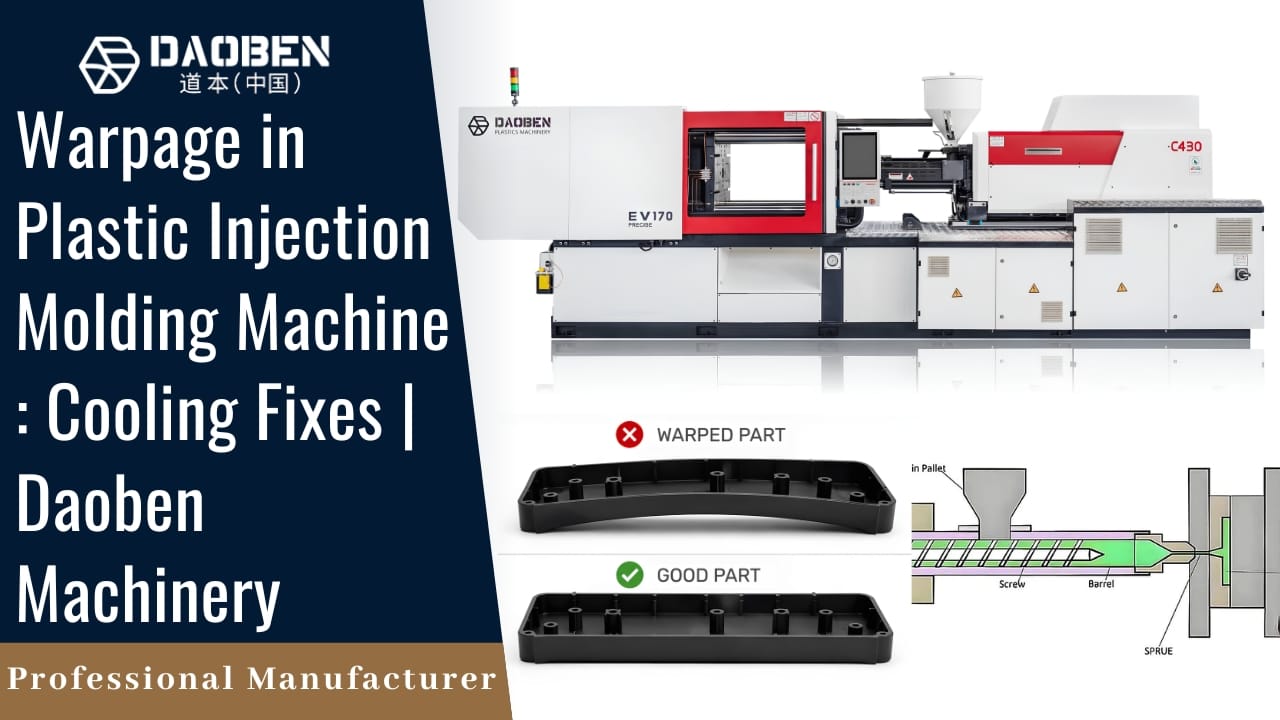
A flat plastic lid that curls at the corners usually points to one root problem: uneven cooling inside the mold. Warpage in injection molding happens when different areas of a part cool and shrink at different speeds. Internal stress builds up, and the part bends, twists, or bows once it leaves the tool.
This defect costs molders real money. Warped parts fail to fit during assembly, get rejected at inspection, and slow the whole line. Worse, they are hard to correct after the fact.
The good news is simple. Most warpage traces back to how heat leaves the mold. So when you control the cooling, you largely control the final shape.
This article breaks down what causes warpage, why cooling matters more than any other factor, and how a smart cooling design keeps parts flat and dimensionally stable.
Quick Answer: Warpage in injection molding is a distortion where a molded part bends or twists because its sections cool and shrink unevenly. Balanced cooling — through correct channel layout, steady coolant temperature, and uniform mold-surface heat — is the most effective way to prevent it and hold tight tolerances.
What Causes Warpage in Injection Molding
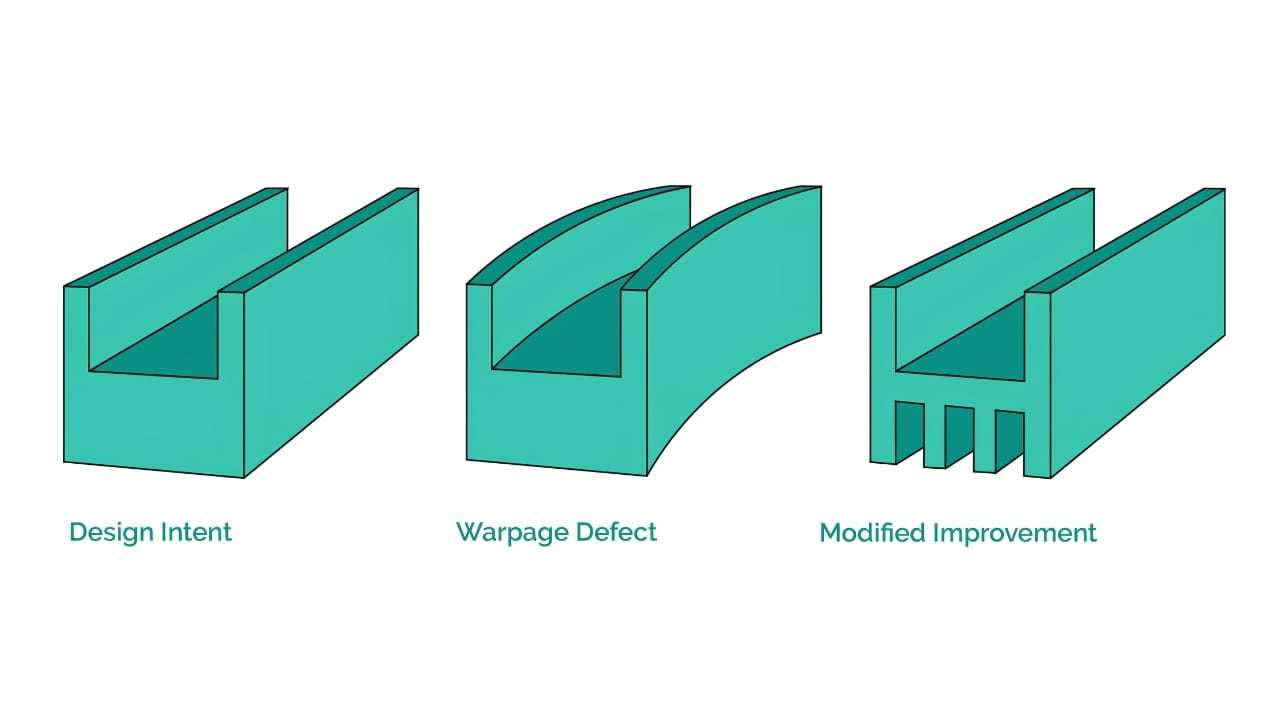
Warpage in injection molding is caused by uneven shrinkage across a part. As the plastic cools, some regions solidify faster than others. These areas shrink at different rates, and the mismatch creates internal stress. When the part is ejected, that stress releases and pulls the geometry out of shape.
Several factors feed into this problem. Still, they almost always link back to heat and how it moves.
Thick and thin sections cool at different speeds. Thick zones hold heat longer, so they shrink later and more. Meanwhile, thin walls set quickly. This difference tugs the part toward the slower-cooling side.
Poor mold temperature control makes the issue worse. If one half of the mold runs hotter than the other, the part cools asymmetrically. As a result, it bows toward the warmer surface.
Packing pressure also plays a role. Too little pressure leaves the material under-packed and prone to sink and shrink. Too much can lock in stress. Both outcomes raise warpage risk.
Differential Cooling and Uneven Shrinkage
Differential cooling is the single biggest driver of warpage. It describes what happens when heat exits one area of the mold faster than another. The fast-cooling side freezes and shrinks first, while the slow side is still soft.
Because the two sides shrink out of sync, the part locks in a curve. Corners, ribs, and bosses are common trouble spots. These features hold extra material, so they cool slower than the walls around them.
Even a 10–15°C gap between the two mold halves can bend a flat part noticeably. Therefore, uniform heat removal is the goal on every tool.
Material Behavior: Amorphous vs Semi-Crystalline Plastics
The resin you choose sets your baseline warpage risk. Amorphous plastics like ABS and polycarbonate shrink at a low, even rate, usually 0.4–0.8%. So they resist warpage fairly well.
Semi-crystalline plastics behave differently. Materials such as polypropylene (PP), nylon (PA), and acetal (POM) crystallize as they cool. This process causes higher and less even shrinkage, often 1.0–2.5%.
Glass-fiber reinforcement adds another twist. Fibers align with the flow, so the part shrinks less along the flow direction and more across it. This directional shrinkage is a leading cause of warpage in fiber-filled parts. You can read how shrinkage is measured under ASTM D955, a standard test method for thermoplastics.
How Cooling Design Controls Warpage in Injection Molding
Cooling design controls warpage in injection molding by making heat leave every part of the mold at the same rate. When cooling is balanced, all sections shrink together. The internal stress that bends parts never builds up in the first place. Channel layout, conformal cooling, and coolant temperature are the three main tools.
Cooling is not a small stage of the cycle. In fact, it often takes up 60–70% of total cycle time. So it deserves the most engineering attention.
A well-designed cooling system does two jobs at once. It removes heat evenly, and it keeps the mold surface temperature uniform. Both outcomes fight warpage directly.
Cooling Channel Layout and Spacing
Cooling channels should follow the shape of the part and sit at a steady distance from the cavity. As a rule, keep channels about 1–2 diameters away from the surface, and space them 3–5 diameters apart. This spacing gives even coverage without cold or hot spots.
Straight, evenly placed channels work for simple flat parts. Complex parts need extra help. Engineers use baffles, bubblers, and thermal pins to push coolant into deep cores and tall ribs. These features reach spots that plain drilled lines cannot.
When one core stays hotter than the rest, that region shrinks last and pulls the part out of line. So targeted cooling in those zones keeps shrinkage even.
Conformal Cooling for Complex Geometry
Conformal cooling takes channel design a step further. Instead of straight drilled lines, these channels curve to match the part surface exactly. Tool makers produce them with 3D-printed metal molds using DMLS (direct metal laser sintering).
Because the channels hug the geometry, heat removal becomes far more uniform. Studies from mold-tooling suppliers report cycle-time cuts of 20–40% and clear reductions in warpage. Round and boxy parts benefit the most.
The trade-off is cost. Conformal molds are pricier to build. Still, for high-volume or tight-tolerance parts, the payback in scrap reduction and speed is often worth it.
Coolant Temperature and Flow Control
Coolant temperature must stay steady and match the material. A mold temperature controller (TCU) holds the setpoint within a tight band, often ±1°C. This stability keeps both mold halves at the same heat level.
Flow rate matters too. Coolant should move in turbulent flow, not smooth laminar flow. Turbulent flow strips heat from the channel walls far more effectively. A Reynolds number above 4,000 usually confirms turbulent conditions.
When temperature and flow are both controlled, the mold cools each shot the same way. As a result, part-to-part warpage drops and dimensions stay repeatable across a long run.
Machine and Process Settings That Reduce Plastic Warpage
The molding machine also shapes warpage outcomes. Precise, repeatable control over pressure, speed, and temperature keeps every shot consistent. Modern electric and hybrid machines hold these values tightly, which reduces plastic warpage across long production runs. Stable machine performance supports stable cooling.
Packing pressure and hold time deserve careful tuning. Enough packing offsets shrinkage in thick zones. Too much, though, forces extra material in and locks in stress. So molders balance the two through short trials.
Injection speed affects how the material fills and freezes. Slower, controlled fill lowers shear stress and gives more even cooling. Fast fill can cause fiber misalignment and uneven flow, both of which raise warpage.
Machine repeatability ties it all together. A machine that drifts shot to shot will cool parts unevenly, no matter how good the mold is. This is one reason many molders compare electric vs hydraulic injection molding machines before buying. Precise motion control pays off in fewer defects. At Daoben Machinery, our injection molding machines run from 30 to 4,000 tons with servo-driven control for stable, repeatable cycles.
Energy use is part of the picture too. Efficient drives run cooler and steadier, which helps thermal stability. This trend is covered well in a report on why energy-efficient injection molding machines are gaining ground.
Material Shrinkage and Warpage Risk by Resin
The table below compares common resins by shrinkage rate and warpage risk. Shrinkage values come from typical processing data and align with test methods like ISO 294-4 for measuring mold shrinkage. Use it as a quick planning reference, not a final spec.
| Material | Type | Typical Shrinkage | Warpage Risk | Notes |
|---|---|---|---|---|
| ABS | Amorphous | 0.4–0.7% | Low | Even shrinkage, forgiving to mold |
| Polycarbonate (PC) | Amorphous | 0.5–0.7% | Low | Stable, holds tight tolerances |
| Polypropylene (PP) | Semi-crystalline | 1.0–2.5% | High | Crystallizes; needs even cooling |
| Nylon (PA6) | Semi-crystalline | 0.8–1.5% | Medium–High | Absorbs moisture; watch drying |
| Glass-filled Nylon | Filled semi-crystalline | 0.2–1.0% directional | High | Strong flow-direction warpage |
| Acetal (POM) | Semi-crystalline | 1.8–2.5% | High | High, uneven shrinkage |
Automotive parts often use filled nylons and PP, so cooling design gets extra scrutiny there. You can see how these choices play out in real work for automotive injection molders.
Frequently Asked Questions
What is warpage in injection molding?
Warpage in injection molding is a defect where a molded part bends, twists, or bows instead of holding its designed shape. It happens because sections of the part cool and shrink at different rates. The uneven shrinkage creates internal stress that distorts the part after ejection from the mold.
Why does uneven cooling cause warpage?
Uneven cooling causes warpage because the fast-cooling side of a part solidifies and shrinks first, while the slow side stays soft. This mismatch builds internal stress. When the stress releases after ejection, the part pulls toward the slower-cooling area and loses its flat, true shape.
How do you prevent warpage in injection molding?
You prevent warpage in injection molding by cooling every section of the part at the same rate. Use balanced channel layouts, keep coolant temperature steady with a controller, and design uniform wall thickness. Conformal cooling and turbulent coolant flow further reduce warpage in complex or thick-walled parts.
Can warped plastic parts be fixed after molding?
Warped parts are difficult to fix once cooled and set. Mild cases can sometimes be corrected with fixtures or annealing, but results are inconsistent. Preventing warpage through cooling design and stable machine control is far more reliable and cheaper than trying to reshape finished parts.
Which plastics warp the most in injection molding?
Semi-crystalline plastics warp the most because they crystallize and shrink unevenly as they cool. Polypropylene, acetal, and glass-filled nylon are common culprits. Amorphous resins like ABS and polycarbonate warp less. Glass fibers add directional shrinkage, so filled materials need especially careful cooling design.
Flat Parts Start With Smart Cooling Design
Warpage in injection molding is not random. It follows the heat. When cooling is uneven, parts shrink unevenly and bend. When cooling is balanced, parts stay flat and hold their tolerances shot after shot.
So the fix starts at the design stage. Match your channel layout to the part, control coolant temperature closely, and pick a resin with your shrinkage goals in mind. Then back it all with a machine that repeats every cycle precisely.
Getting cooling right cuts scrap, speeds up production, and protects your margins. That is why molders serious about quality treat cooling design as a core discipline, not an afterthought.
If you want machines built for stable, repeatable cycles across a wide tonnage range, explore the Daoben injection molding machine lineup or check current pricing in our 2025 injection molding machine price guide. Our team can help you match tonnage and control precision to your part and material.